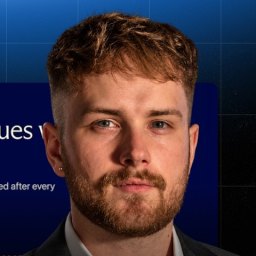
Srinivas says Perplexity is investing in Comet, a browser that combines navigation, search, and an assistant. He imagines users running several tasks at once, with access to sources such as email, calendars, and other accounts. The browser could also let an agent work across tabs, fill forms, and handle recurring research tasks.
Aravind Srinivas: Perplexity's Race to Build Agentic Search
Speaker
Aravind Srinivas, co-founder and CEO of Perplexity, discusses the company’s move from AI search toward browser-based agents with a Y Combinator host and audience.
Perplexity began with natural-language search over relational data from sites such as Twitter, LinkedIn, and GitHub. The team saw sustained use, then expanded the idea to web search that returned answers with sources. Srinivas recalls nearly 700,000 queries on New Year’s Eve as the point when user interest convinced him the product had potential.
Srinivas expects well-funded companies to copy successful products, so Perplexity focuses on answer and task accuracy, speed, and coordinating tools. He says the browser is a harder product to copy than another chat tool, while acknowledging that OpenAI and Anthropic could build browsers too. His advice to founders is to expect competition and keep shipping.
Perplexity requires employees to use at least one AI coding tool, with Cursor common internally and some teams also using GitHub Copilot. Srinivas says these tools can turn an algorithm implementation and experiment from three or four days into about an hour. He still values software engineering, infrastructure, and distributed-systems skills, especially for production work.
Srinivas sees subscriptions, task-based pricing, and a share of purchases as possible revenue sources, though he expects Perplexity may never match Google’s profits. For accuracy, he points to better search indexing, stronger page snippets, and models that can reason through multiple steps. He also describes partnerships across hotels, maps, shopping, finance, and sports, and says distribution should expand through both overlapping and new audiences.
Takeaways
- Build an early version, put it in users’ hands, and look for sustained use after the initial excitement fades.
- Assume successful products will attract copies; sharpen a clear identity and keep improving the product.
- Use coding assistants to speed up experiments, while maintaining the engineering expertise needed to understand and support production systems.
- For agent products, consider whether a browser can act across websites when dedicated integrations are unavailable.
- Treat accuracy as ongoing work across search data, source quality, and model reasoning.
Mentioned in this talk


Search inside this talk
What was claimed 15
- featureComet: Can run multiple tasks asynchronously and access personal contacts, email, calendar, and other accounts
“launch several tasks in parallel that run asynchronously”
YouTube Unverified1 source· Talk
- featureComet: Combines navigation, informational search, and agentic tasks in a browser assistant
“one omnibox where you can navigate, ask informational queries, and give agentic tasks”
YouTube Unverified1 source· Talk
- role atAravind Srinivas is CEO at
 Perplexity
“what the CEO of a large company would do”
YouTube Verified2 sources· Talk
- metricPerplexity: About 200 employees
“we have about 200”
YouTube Unverified1 source· Talk
- usesPerplexity uses
 GitHub Copilot
“some people using a mix of Cursor and GitHub Copilot”
YouTube Unverified1 source· Talk
- usesPerplexity uses
 Cursor
“It happens to be Cursor”
YouTube Unverified1 source· Talk
- integrates withPerplexity integrates with Stats Perform
“In sports, we work with Stats Perform”
YouTube Unverified1 source· Talk
- integrates withPerplexity integrates with FMP
“In finance, we work with FMP”
YouTube Unverified1 source· Talk