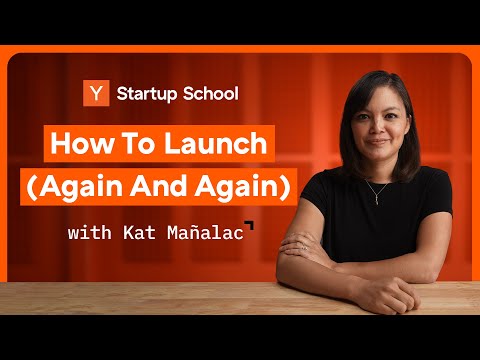
Mañalac argues that launching is not a single high stakes event but a repeated process as a startup ships products and features. A team that spends six months polishing its first launch may run out of time before it gets another chance. Launching early also helps founders practice their pitch and learn how people respond.
How to Launch (Again and Again)
Speaker
Kat Mañalac, a Y Combinator partner, explains how founders can launch continuously, with examples from YC companies and advice for Startup School founders.
A simple landing page can introduce the company, explain the product, provide contact details, and invite people to act. Mañalac recommends testing an idea with friends and family, then moving quickly to strangers who better match the intended users. Lugg tested demand before its app worked by helping IKEA shoppers with a truck, confirming that moving their purchases was an urgent problem.
YC founders can test products with peers on Bookface or the Startup School forum, which Mañalac says had about 40,000 founders. Magic shared a basic text based service that spread to Reddit and Hacker News, bringing 40,000 signups over a weekend, though she describes this as an unusual outcome. For community posts, she advises founders to learn each site's rules, write naturally, explain what they learned, and invite relevant questions.
A waitlist can help manage demand and encourage referrals, as Magic and Superhuman demonstrated. Joy contacted more than 50 wedding bloggers and got four responses that meaningfully contributed to early growth. Stripe repeatedly launched products through its blog, Hacker News, social media, and press, while Glossier used a regular product cadence and repeated its launch activities every six to eight weeks.
Symetra founder Gaddy Avron kept an email list of people he met while discussing the company, then asked them to share its TechCrunch story. Mañalac recommends that founders start collecting contacts and sending occasional updates before they have a product. Her closing advice is to keep testing launches throughout a company's life rather than reserving effort for one big day.
Takeaways
- Launch a simple page early to test whether your pitch is clear.
- Use friends and family for an initial check, then seek feedback from likely customers.
- Try multiple channels to learn which audiences respond to your product.
- Follow each community's rules and write plainly about what you are building and learning.
- Build an opt-in contact list over time and ask people to help spread meaningful updates.
Mentioned in this talk


Search inside this talk
What was claimed 9
- role atKat Mañalac is partner at
 Y Combinator
“a partner at Y Combinator”
YouTube Unverified1 source· Talk
- builtProduct Hunt built Ship
“So we built Ship.”
3:10inCommunicate with Users, Build Something They WantYouTube Verified2 sources· Talk
- featureLugg: On-demand movers and delivery people
“Lugg is an app that lets you call movers and delivery people on demand.”
YouTube Unverified1 source· Talk
- feature
 Magic: On-demand personal assistant service
“Magic is an on-demand personal assistant.”
YouTube Unverified1 source· Talk
- metricMagic: 40,000 people signed up over a weekend
“Over the course of a weekend, 40,000 people signed up to use Magic.”
YouTube Unverified1 source· Talk
- featureSuperhuman: Requests access and offers referrals to help people skip the waitlist
“You can go to their site and request access, or ask a current user to refer you”
YouTube Unverified1 source· Talk
- metricJoy: Reached over 50 bloggers and received four responses
“They reached out to over 50 bloggers in a drip campaign and only got responses from four”
YouTube Unverified1 source· Talk
- featureJoy: Free wedding website builder
“Joy is a free wedding website builder”
YouTube Unverified1 source· Talk
Related talks
 21:07
The Best Way To Launch Your Startup
Feb 9, 2023
 49:01
 31:00
 30:29
 5:41
How To Get Your First Users
Jan 14, 2026
 25:41