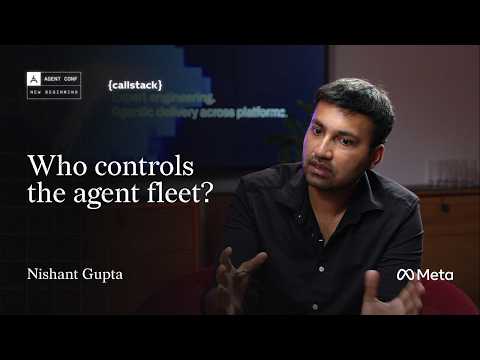
Gupta says building a single agent is relatively straightforward; the challenge is tracking what data thousands of agents touch, what access they have, and who is accountable. He groups failures into system design problems, conflicts between agents, and a lack of verification. Examples include agents looping, failing to terminate, or disagreeing over which agent has authority.
The Agent Control Plane: Managing Thousands of AI Agents
Speaker
Nishant Gupta, who works at Meta on distributed training and inference infrastructure, explains how to govern and safely operate large fleets of AI agents at Agent Conf 2026, in a talk hosted by Callstack.
Gupta defines the agentic control plane as a governing layer separate from the agents, with seven core functions: life cycle management, policy enforcement, permissions, evaluations, coordination, observability, and human escalation. A unified inventory helps teams find agents and establish ownership. Runtime policies can set token or compute limits, while scoped identities apply least privilege.
Gupta recommends both offline evaluations against a golden dataset and online evaluations using sampled real traffic, with humans or LLMs as judges. Multi-agent coordination needs explicit protocols rather than informal English. Full-fidelity OpenTelemetry traces can record model calls, tool calls, data exchanges, and permissions; predefined escalation triggers can send cases such as refunds above $5,000 to a human.
Gupta recommends gradually routing traffic to new agent versions and comparing them against production on measures such as cost, latency, and throughput. Scoped kill switches can disable a particular agent, tool, or MCP server for selected tenants within seconds. Fleet-wide cost limits and anomaly detection can catch runaway workflows, cost or latency spikes, and drops in evaluation accuracy.
Gupta's roadmap starts with one clearly scoped agent, human approval for consequential actions, and full tracing. The next stage uses two to five agents with explicit task boundaries, least-privilege access, and automated evaluations on real traffic. The final stage adds policy as code across the fleet, along with canary rollouts, kill switches, inventory, and observability.
Takeaways
- Track agent ownership, data access, and lifecycle in a searchable fleet inventory.
- Enforce budgets and permissions outside agent prompts with policies and scoped identities.
- Use explicit protocols for agent coordination and trace model, tool, data, and permission activity.
- Roll out changes gradually, set fleet-wide limits, and define when humans must review or intervene.
- Expand from a closely supervised agent to a small evaluated group, then apply fleet-wide controls.
Mentioned in this talk


Search inside this talk
What was claimed 6
- works atNishant Gupta works at
 Metasoftware engineering tech lead
“I'm a software engineering tech lead at Meta”
0:03inProduction Evals For Agentic AI SystemsYouTube Verified6 sources· Talk, Web· archived
- featureAgentic control plane: Seven governing functions: life cycle management, policy enforcement, permissions, evaluations, coordination, observability, and escalation
“They are life cycle management, policy enforcement, permissions, evaluations, coordination—multi-agent coordination in our context—observability, and escalation”
YouTube Unverified1 source· Talk
- usesExplicit, framework-agnostic coordination protocol for agents
“Google has the A2A protocol, which is agnostic to the framework, model, or tools you use”
YouTube Unverified1 source· Talk
- usesFull-fidelity traces for model calls, tool calls, data exchanges, and permissions
“full-fidelity traces using OpenTelemetry (OTel)”
YouTube Unverified1 source· Talk
- featureCanary rollouts: New agent versions initially serve a small percentage of traffic before handling all traffic
“it should initially serve a small percentage of traffic for a short time, before handling all the traffic”
YouTube Unverified1 source· Talk
- featureCrawl, walk, run approach: Crawl begins with one agent and human approval for consequential actions; Walk uses two to five agents; Run applies policy-as-code control across the fleet
“In Stage One, Crawl ... we start with a single agent”
YouTube Unverified1 source· Talk