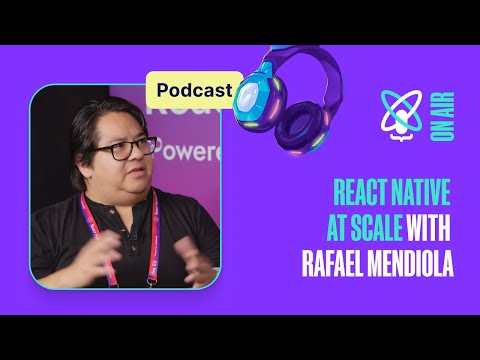
The discussion distinguishes Android Open Source Project (AOSP), which provides the base operating system, from Google Mobile Services (GMS), a separate layer of proprietary services. AOSP can suit single-purpose devices, such as screens in taxis, while other devices may need services for authentication, maps, or notifications. Device makers can also add their own services.
Open Mobile Hub: Modules for Non-GMS Devices and Beyond
Speakers
Diego Zul Laga, Technical Solutions Director at Open Mobile Hub within Futurewei, and Callstack’s Kuba Łatki discuss OMH’s Android and React Native modules on the React Native Show podcast with host Łukasz Kinski.
Open Mobile Hub offers a common interface for Android and cross-platform apps to use services from different providers. The goal is to reduce the work of switching SDKs and help apps serve regions where GMS or particular services are unavailable. The initiative is hosted by the Linux Foundation Europe to support open collaboration and neutral governance.
The modules discussed are Maps, Authentication, and Storage. Maps supports Android, React Native, and iOS, with Mapbox, OpenStreetMap, Azure Maps, and Google Maps; Authentication supports OAuth 2.0 providers including Dropbox, Google, Microsoft, and Facebook. Storage connects to services including Google Drive, Dropbox, and OneDrive, using authentication to access a user’s account.
OMH has a native Android SDK layer and a React Native layer built on the native SDKs. Developers add modules through Gradle dependencies and use clients with provider plugins behind them. The shared interface covers common needs, while an escape hatch lets developers access provider-specific capabilities.
The OMH website links to setup guides, samples, documentation, API references, and GitHub repositories. The team welcomes developers and service providers to contribute plugins, report bugs, and share feedback to inform the roadmap. The episode describes some components as ready to use and others as early access.
Takeaways
- A common service interface can lower the effort of evaluating or changing mobile service providers.
- Check which services an app actually needs before choosing a GMS or AOSP deployment.
- Authentication can be a dependency for storage integrations and may also support personalized services.
- A shared API can cover common use cases while retaining access to provider-specific features.
- Provider coverage and module maturity vary, so confirm support for the target platforms and services.
Mentioned in this talk


Search inside this talk
What was claimed 23
- featureKack: Software engineering consultancy
“this podcast is brought to you by Kack, the total software engineering consultancy.”
YouTube Unverified1 source· Talk
- featureOpen Mobile Hub: Provides developer tooling and SDKs to address fragmentation and interoperability in Android native and cross-platform apps
“I enable developers by providing developer tooling and SDKs that address fragmentation and interoperability issues in Android native and cross-platform apps.”
YouTube Unverified1 source· Talk
- role atDiego Zul Laga is Technical Solutions Director at Open Mobile Hub
“I’m the Technical Solutions Director at Open Mobile Hub, or OMH, within Futurewei.”
YouTube Unverified1 source· Talk
- previously atDiego Zul Laga previously at
 GoogleDeveloper Relations Engineer and software developer
“In the past, I worked at Google as a Developer Relations Engineer and software developer.”
YouTube Unverified1 source· Talk
- role atKuba Łatki is Business analyst at
 Callstack
“I'm Kuba. I'm a BA working with Callstack.”
YouTube Unverified1 source· Talk
- integrates withOpen Mobile Hub integrates with Google Mobile Services
“OMH provides services for native developers, more specifically for Android, both GMS and non-GMS.”
YouTube Unverified1 source· Talk
- featureOpen Mobile Hub: Common provider interface and provider switching to reduce vendor lock-in
“Why not have a common, unified interface for these service providers that wraps them and provides the same affordances?”
YouTube Unverified1 source· Talk
- uses
“We needed to be part of an organization ... We couldn’t think of a better foundation for this than the Linux Foundation Europe.”
YouTube Unverified1 source· Talk