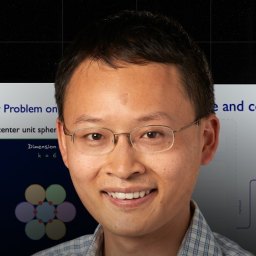
Susskind says his ideas came from trying to resolve apparent contradictions, such as why quarks seem to exist inside protons but cannot be observed alone. He describes himself as mainstream and says that sometimes a seemingly outlandish idea is the only way to make conflicting principles fit.
Richard Feynman, the Holographic Principle, and Unanswered Questions in Physics
Speaker
Leonard Susskind, theoretical physicist at Stanford, discusses his work and open questions in physics with a Y Combinator host.
Susskind traces his string theory work to formulas describing hadrons, whose spin and excitations suggested vibrating strings. He considers string theory a mathematically consistent laboratory for studying quantum mechanics and gravity, while leaving open whether a modified version describes real particles.
Susskind calls the connection between quantum mechanics and gravity a central problem, alongside cosmological puzzles such as why dark energy is so small. He explains the holographic principle through black holes: information that falls in can also be represented at the horizon, and a universe may likewise be described by information at its boundary.
Susskind explores whether gravity’s laws may emerge from quantum mechanics, discussing the ER=EPR idea that connects entanglement with Einstein-Rosen bridges. He links wormhole growth to quantum complexity, a measure of how difficult it is to reverse a process, and says quantum computers could help simulate complex quantum systems.
Susskind recalls Feynman’s dislike of jargon and says clear explanations can help physicists sharpen their own ideas. He sees discovery as the physicist’s role and argues that teaching the public was both enjoyable and a way to help people distinguish established science from unsupported claims.
Takeaways
- Treat persistent contradictions as clues that a theory may need revision.
- Use mathematical theories as useful tools without assuming they describe nature exactly.
- Separate what a framework predicts from what remains experimentally established.
- Explain complex ideas plainly to expose gaps in your own understanding.
- Quantum teleportation still needs classical communication, so it cannot transmit information faster than light.
Mentioned in this talk
 Stanford UniversityCERNString theoryQuantum mechanicsQuantum gravityLarge Hadron ColliderDark energyHolographic principleER=EPR hypothesisEinstein-Rosen bridgeQuantum entanglementQuantum complexity theoryQuantum teleportationQuantum information science and technologyClassical computerOccam's razorAnthropic principleFreeman DysonGerard 't HooftRichard FeynmanStephen HawkingJuan MaldacenaHans Bethe
Search inside this talk
What was claimed 10
- role atLeonard Susskind is physicist atStanford University
“now here we are at Stanford”
YouTube Unverified2 sources· Talk
- builtco-created
“You're credited as one of the creators of string theory.”
YouTube Unverified1 source· Talk
- metricLeonard Susskind: about 10 to the minus 120 of the natural expectationabout 10 to the minus 120 of the natural expectation
“It's 10 to the minus 120 of what the natural expectation for it would be.”
YouTube Unverified1 source· Talk
- builtdeveloped the idea
“the holographic principle that you worked on”
YouTube Unverified1 source· Talk
- builtindependently put forward the idea
“Gerard ’t Hooft also put this idea forward”
YouTube Unverified1 source· Talk
- builtprovided a rigorous version in certain setups
“the work of Juan Maldacena, who made a really rigorous, beautiful version of it”
YouTube Unverified1 source· Talk
- builtco-authored related work with a collaborator
“discovered by myself and probably more by my collaborator, Mel, than myself—we wrote a paper together”
YouTube Unverified1 source· Talk
- featureLeonard Susskind: requires classical information to complete the transferrequires classical information to complete the transfer
“you cannot do it without at the same time sending classical information”
YouTube Unverified1 source· Talk