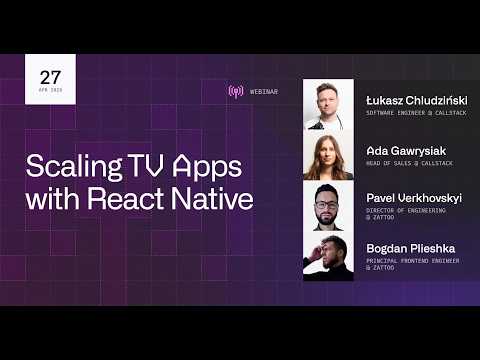
The guests describe a fragmented landscape that includes Android TV, Fire TV, Roku, Samsung Tizen, LG webOS, and Apple TV. Supporting older devices can mean working around platform-specific accessibility, browser, and JavaScript limitations. Tizen apps may need React Native for Web and older JavaScript compatibility.
TV App Development With React Native Is Not Just Mobile, But Bigger
Speakers
Wuk Kinski, host of React Universe On Air at Callstack, talks with Mike Kirala of DIRECTV and Chris Tracz of Amazon about building and testing React Native apps across fragmented TV platforms.
The guests say multiplatform work can help teams focus on user needs and business requirements instead of solving the same implementation problems separately. Shared work also encourages mobile, web, and backend teams to coordinate. React Native still leaves platform-specific work, including custom focus behavior, accessibility, and performance tuning.
The DIRECTV team describes testing candidate packages against a stated problem and hypothesis, then weighing performance, functionality, and developer experience. For example, it uses Zustand for state in some areas while retaining Redux and RTK Query for networking and CRUD flows. Chris describes Amazon testing React Native libraries for Fire OS compatibility and contributing platform filters to React Native Directory.
Mike recommends unit tests, integration tests, and focused end-to-end tests. He favors integration tests for balancing runtime with coverage, including simulated focus management and user journeys. For end-to-end testing, DIRECTV uses AWS Device Farm and in-house devices, while Chris emphasizes real-device checks for confidence.
The guests note that simulators cannot fully represent older, lower-powered TV hardware, and that capture cards can make device testing easier while limiting some playback. A Fire TV Stick may remain in use for years after a household upgrades its television. Chris also points to remote-based account setup as a first-launch problem teams should address.
Takeaways
- Catalog each target platform's accessibility, focus, browser, and device constraints before committing to a shared implementation.
- Trial community libraries with a clear hypothesis and proof of concept; keep tools that solve a demonstrated need.
- Use integration tests for broad user-journey coverage, then reserve end-to-end tests for simple, critical flows.
- Test on representative real devices, including older hardware, and parallelize device runs to keep pull request feedback timely.
- Make first-launch sign-in practical for a TV remote, since typing credentials on a television creates user friction.
Mentioned in this talk
DIRECTVAmazonFire devicesExpo ModulesRoku Apple TVFlashListReact Native DirectoryAWS Device FarmReact Native Testing Librarycapture card
 React NativeAndroid TVTizenReact Native WebAndroid Open Source ProjectwebOSKotlin Multiplatform
 ReduxZustandFire OS
 Jestintegration testingfocus managementmanual testing
Apple TVFlashListReact Native DirectoryAWS Device FarmReact Native Testing Librarycapture cardReact NativeAndroid TVTizenReact Native WebAndroid Open Source ProjectwebOSKotlin MultiplatformReduxZustandFire OSJestintegration testingfocus managementmanual testingSearch inside this talk
What was claimed 14
- usesAmazon uses React Native
“all the places Amazon is using it”
1:58inReact Native EU 2023 Q&A PanelYouTube Verified2 sources· Talk
- usesDIRECTV uses React Native
“building a multiplatform React Native codebase and application”
YouTube Unverified1 source· Talk
- role atMike Kirala is senior director of engineering at DIRECTV
“I'm the senior director of engineering for our client team”
YouTube Unverified1 source· Talk
- role atChris Tracz is leads developer evangelism for Fire devices at Amazon
“I lead developer evangelism for Fire devices”
YouTube Unverified1 source· Talk
- integrates withReact Native Web integrates with React Native
“you have to use React Native for Web”
YouTube Unverified1 source· Talk
- integrates withFire OS integrates with Android Open Source Project
“Fire TV, which is a fork of AOSP”
YouTube Unverified1 source· Talk
- uses
“We're still using Redux; we don't plan to remove it”
YouTube Unverified1 source· Talk
- uses
“we landed on Zustand”
YouTube Unverified1 source· Talk