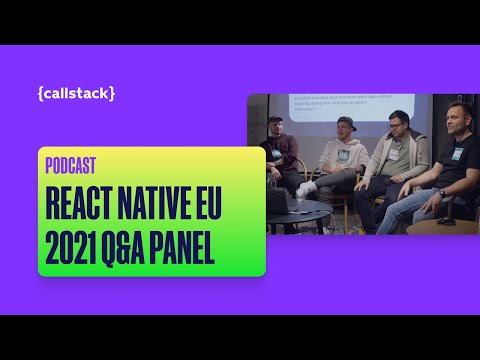
Panelists valued being able to attend remotely and hear technical talks from developers around the world. Ram said the active Slack conversations helped recreate the community side of an in-person event, while Kudo appreciated being able to participate alongside family commitments.
Q&A Panel
Speakers
Mike, React Universe On Air host at Callstack, leads a React Native EU 2020 panel with Eloy, Ram, Monica, Kudo, and Rob on React Native’s new architecture, multiplatform development, performance, and app migrations.
Ram said Fabric and TurboModules were being tested internally, with performance and stability work underway; he expected a gradual rollout rather than a single release date. Much of the code was public, but building it required work because Facebook used Buck, and the Android Gradle setup still needed community help. Panelists highlighted TurboModules for type safety and startup performance, JSI as a foundation, and Fabric for synchronous UI work and support for additional platforms.
Eloy said JavaScript and data layers can often be shared, while desktop apps still need platform-specific interactions and APIs. A panelist described reaching about 50 percent code sharing across desktop and web, while noting gaps such as mouse-over feedback, drag and drop, and multiple windows. The group stressed that shared code should still let apps follow each platform’s design conventions.
Kudo described React Native Skia as an experiment for learning Fabric and exploring another rendering platform, though it still needed pieces such as a compositor. Ram framed synchronous and asynchronous work as complementary tools for user experience, rather than competing approaches. Eloy said keeping React Native macOS current involved manually reapplying changes, while Windows and Android used automated patches; he saw smaller packages and shared platform code as possible ways to ease maintenance.
Ram traced a sluggish JavaScript thread using a sampling profiler and described an open-source visualization tool built by MLH Fellowship contributors for Hermes profiles. Monica said a major MLS app upgrade involving AndroidX, DEX, and library updates was challenging but brought performance gains. For migrations, panelists advised splitting work into chunks, checking library compatibility, keeping native code where useful, and supporting native engineers as teams adopt React Native.
Takeaways
- Treat the new architecture as a gradual transition; track discussions, releases, and proposals for updates.
- Profile JavaScript thread bottlenecks, and use Hermes sampling data to find what is blocking interactions.
- Share platform-independent code while designing UI and interactions for each platform.
- For desktop and web targets, plan for platform-specific needs such as drag and drop, pointer input, and multiple windows.
- Migrate incrementally, check native library compatibility early, and include native expertise in React Native teams.
Mentioned in this talk


Search inside this talk
What was claimed 21
- uses
“Most of our products at MLS are built or being built using React Native or React JS”
0:35inThe great Divide: Bridging Native Modules And React NativeYouTube Verified3 sources· Talk
- uses
“getting React Native for macOS up to speed with the other versions”
YouTube Unverified1 source· Talk
- role at
“I’m working on getting React Native for macOS up to speed”
YouTube Unverified1 source· Talk
- works at
“I currently work at Microsoft on their React Native needs in Office.”
YouTube Unverified1 source· Talk
- previously at
“That’s how I found my way to React Native when I worked at Artsy.”
YouTube Unverified1 source· Talk
- works atParashuram Ram works at Oculus
“I’m currently working at Oculus.”
YouTube Unverified1 source· Talk
- role atParashuram Ram is engineering manager at
 Meta
“I’m an engineering manager at Facebook”
YouTube Unverified1 source· Talk
- builtParashuram Ram built CodePush
“I was a PM on CodePush”
YouTube Unverified1 source· Talk