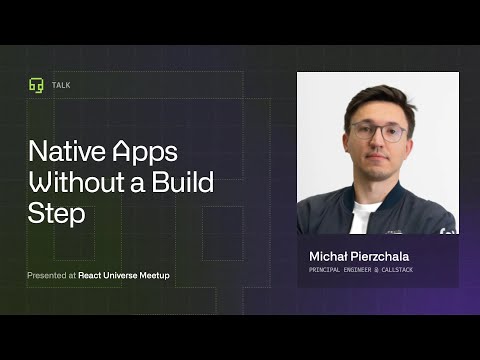
Chapple traces the path from generating and shipping an app to managing updates, app store review, and a growing team. As more developers contribute, a production break can disrupt releases, and partial rollbacks are difficult in a monolithic React Native app.
Actually Distributed Mobile Development at Scale
Speaker
Zackary Chapple, CEO and co-founder of Zephyr Cloud, explains how teams can develop and release React Native applications independently at React Universe Conf 2025 with Callstack.
He compares mobile development with the evolution of back-end and web architectures, from monoliths to microservices and micro frontends. He describes the tradeoffs of iframes and independently updated packages, including fragmented tools and many pull requests to coordinate changes.
Chapple presents Module Federation as a way to expose and consume application modules, with a mental model similar to Docker. He outlines its evolution from webpack to Rspack and version 2.0, and describes work with Callstack to add Metro support to Module Federation Core.
With Module Federation, teams can ship mini apps independently from their own infrastructure, such as an S3 bucket or CDN. Chapple says this can reduce dependence on app store releases, but multiple environments can create unwieldy configuration; he cites one e-commerce company with 250 lines of config.
Chapple describes Zephyr as a way to manage environments, tags, versions, and rollbacks for federated modules. He reports a deployment to Cloudflare’s edge in 260 milliseconds and says Southern Glazer’s Wine & Spirits went from releases taking about two months across environments to deploying in under a second after adopting Re.Pack and Module Federation.
Takeaways
- Break a large mobile app into modules so teams can release at different speeds.
- Plan how modules resolve across development, staging, and production before configurations multiply.
- Independent module releases can reduce the need to wait for a full app store release.
- Keep rollback paths available for each deployed module and environment.
- Test combinations of mini app versions to speed up field testing.
Mentioned in this talk


Search inside this talk
What was claimed 12
- foundedZackary Chapple founded Zephyr Cloudco-founder
“I'm the CEO and co-founder of a company called Zephyr Cloud.”
YouTube Unverified1 source· Talk
- ceo ofZackary Chapple CEO of Zephyr Cloud
“I'm the CEO and co-founder of a company called Zephyr Cloud.”
YouTube Unverified1 source· Talk
- featureModule Federation: Allows teams to independently deploy application modules and share dependencies.
“They talk a lot about what they consume and expose, what their dependencies are, and what kinds of things they're sharing.”
YouTube Unverified1 source· Talk
- integrates withModule Federation integrates with webpack
“It actually started in webpack.”
YouTube Unverified1 source· Talk
- integrates withModule Federation integrates with Rspack
“We worked with the Rspack team.”
YouTube Unverified1 source· Talk
- integrates withModule Federation integrates with Vite
“We started adding things like Vite support.”
YouTube Unverified1 source· Talk
- integrates withModule Federation integrates with Metro
“We merged the pull request to make Module Federation Metro part of Module Federation Core itself.”
YouTube Unverified1 source· Talk
- featureZephyr Cloud: Manages Module Federation configuration and lets teams follow environments, tags, or pinned versions.
“Now you can treat it like npm: you can follow an environment, like staging, or a tag; you can follow a specific version.”
YouTube Unverified1 source· Talk
- usesZephyr Cloud uses
 Cloudflare
“It was all running on our Cloudflare infrastructure.”
YouTube Unverified1 source· Talk
- metricZephyr Cloud: 260 milliseconds to deploy a React Native application update to the edge
“It took 260 milliseconds to deploy to the edge.”
YouTube Unverified1 source· Talk
- metricSouthern Glazer’s Wine & Spirits: Mobile application deployment across environments reduced from about two months to under a second.
“Their releases took about two months ... deploying their mobile application in under a second.”
YouTube Unverified1 source· Talk
- uses
“After we introduced Module Federation, we brought Callstack on site for a week.”
YouTube Unverified1 source· Talk