Panelists recommend making contribution steps clear, offering mentorship, and creating approachable starter issues. Emily describes Facebook issues that broke larger tasks, such as adding Flow types to native modules, into listed files and instructions; 40 to 50 files drew pull requests within a day. The panel also hears how a Mongolian React Native group grew to 1,100 members and funded translated documentation through meetups and donations.
Q&A Panel
Speakers
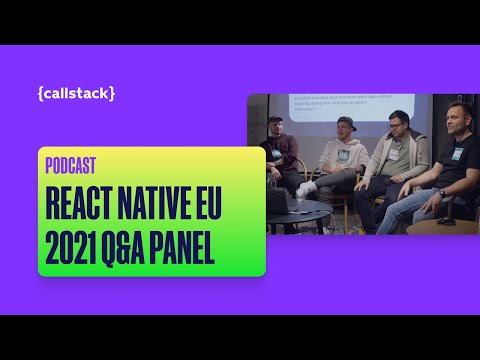
Callstack’s Albert hosts the React Native EU 2019 Q&A panel with contributors and engineers from G2i, Facebook, and the wider React Native community, discussing contribution, platform support, hiring, product quality, and what comes next for React Native.
Panelists identify package quality, compatibility across React Native versions, and the difficulty of maintaining JavaScript, Android, and iOS code as ongoing challenges. They describe Android support as improving, while noting that tooling and emulator gaps can lead teams to test iOS more often. One panelist recommends trying a physical Android device to reduce testing friction.
Hiring advice centers on JavaScript and React fundamentals, readable code, and willingness to learn native languages and platform behavior. On reaching 1.0, the panel says the label alone would not resolve concerns; the Lean Core effort is one example of making React Native smaller and more stable by moving components such as WebView into separate repositories. Panelists also point to documentation improvements, including better coverage of differences between iOS and Android.
Panelists advise developers to keep up with changes, build personal projects, help with issues, and learn how the underlying platforms work. Facebook tracks time to recent content, which goes beyond time to interaction to account for fetching fresh server content. The team also describes fixing flicker and animation issues to improve the perceived quality of React Native experiences.
The panel discusses support for platforms beyond iOS and Android, including Windows and macOS, and says the core team wants to make React Native easier for others to integrate and maintain. Panelists cite Hermes, Microsoft’s involvement, and the community’s growth as reasons for optimism. Albert highlights autolinking as a way to make native module dependencies easier to manage.
Takeaways
- Break contribution work into clear starter tasks and pair them with welcoming mentorship.
- Treat native package maintenance as a cross-platform responsibility, and improve compatibility guidance.
- Evaluate React Native hires for JavaScript fundamentals and willingness to learn native platform skills.
- Measure when users see fresh content, not only when they can first interact.
- Learn by building, contributing to issues, and understanding the native platforms underneath React Native.
Mentioned in this talk


Search inside this talk
What was claimed 10
- works at
“I'm Albert from Callstack.”
YouTube Unverified1 source· Talk
- works atParis Athena works at
 G2i
“I'm on the hiring team and platform team for G2i.”
YouTube Unverified1 source· Talk
- role at
“I'm on the React Native core team here at Facebook.”
YouTube Unverified1 source· Talk
- role at
“I also work at Facebook on the React Native core team.”
YouTube Unverified1 source· Talk
- foundedMike founded Coastline City
“I'm a decorator and organizer, a founder of Coastline City.”
YouTube Unverified1 source· Talk
- useshundreds of apps in the Microsoft Store use it
“The Settings team is using React Native”
4:23inReact Native at Scale: How Microsoft is betting big on React Native to target BILLIONS of usersYouTube Verified6 sources· Talk
- uses
“At Microsoft, we have React Native macOS and React Native Windows”
16:06inMultiplatform Aspect of React NativeYouTube Verified2 sources· Talk
- role atRachel Neighbors is documentation and community outreach team member at
 Meta
“Rachel Neighbors just joined our team to work on documentation and community outreach.”
YouTube Unverified1 source· Talk
- metricTTRC: Time to recent content; measures beyond time to interaction whether recent content has finished fetching
“TTRC, or TTI-C, is time to recent content”
YouTube Unverified1 source· Talk
- integrates with
 Microsoft integrates with React Native
“we work with Microsoft and UWP”
YouTube Unverified1 source· Talk