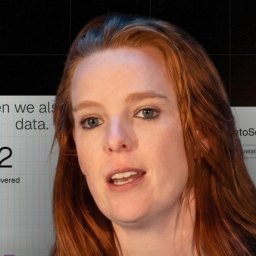
Finn says robotics applications often require separate companies to build custom hardware, software, and movements for each setting. Physical Intelligence is pursuing a model that can help different robots perform different tasks. She argues that large-scale data is necessary, but industrial, video, and simulation data each have limits in task diversity, learning value, or realism.
Chelsea Finn: Building Robots That Can Do Anything
#Robot Learning#Language Models#Training Data#Model Training#Fine-Tuning#Reinforcement Learning#Synthetic Data
Speaker
Chelsea Finn, co-founder of Physical Intelligence, presents at a Y Combinator event on building general-purpose robots, with an audience Q&A.
Finn describes training a robot to fold laundry, beginning with single shirts and gradually adding crumpled clothing and varied items. After months of poor results, the team improved performance by pre-training on broad robot data and fine-tuning on curated demonstrations. A 3-billion-parameter vision-language model further improved speed and folding consistency: the robot folded five items in nine minutes and handled some clothing it had not seen during fine-tuning.
To test whether robots could work in unfamiliar places, the team collected tidying data across more than 100 rooms and combined it with other robot and instructional data. The mobile-manipulation data made up only 2.4% of the pre-training mixture. In three unfamiliar Airbnbs, the robot tidied kitchens and bedrooms; tests also showed that broader environmental diversity improved performance, though success was around 80% and failures remained.
Finn describes a hierarchical system that turns user requests into verbal subtasks for a lower-level robot policy. The team used language models to generate hypothetical prompts from existing robot demonstrations, avoiding the need to collect every interaction directly. The system handled requests such as making a sandwich without pickles and corrections to clean up only the trash, while existing foundation models performed worse in the team's instruction-following evaluation.
Finn says real-world robot data is important but not sufficient, and that general-purpose robots still need more research before they can reliably handle open-world tasks. In the Q&A, she points to reinforcement learning as a way to improve success and speed, and discusses the need for fast on-robot inference and infrastructure for multimodal data. She also says simulation may help with evaluation, while online robot experience can support post-training.
Takeaways
- For complex robot tasks, combine broad pre-training with fine-tuning on consistent, high-quality demonstrations.
- Increase task difficulty gradually so failures are easier to diagnose and the model can build on simpler skills.
- Use diverse training environments to improve transfer, and measure performance in unfamiliar settings.
- Generate varied language prompts from existing demonstrations to train high-level instruction following.
- Plan for real-time inference and recovery from mistakes; strong task demonstrations alone do not ensure reliable deployment.
Mentioned in this talk
Search inside this talk
What was claimed 9
- featurePi Labs: Develops a general-purpose model intended to enable any robot to do any task in any environment
“we're trying to develop a general-purpose model that can enable any robot to do any task in any environment”
YouTube Unverified1 source· Talk
- uses
“we pre-trained on all the data and then fine-tuned on a highly curated, consistent, high-quality set of demonstration data”
YouTube Unverified1 source· Talk
- uses
“We use a variant of diffusion called flow matching to output continuous actions”
YouTube Unverified1 source· Talk
- featurePaliGemma: Takes robot images and a language command as input and predicts a chunk of 50 future actions
“predicts a chunk of 50 actions into the future”
YouTube Unverified1 source· Talk
- uses
“We took an open-source vision-language model, a three-billion-parameter model called PaliGemma”
YouTube Unverified1 source· Talk
- featureVision-language-action models: Can use a high-level policy to break prompts into intermediate language commands for a low-level robot model
“A high-level policy breaks down the prompt into intermediate verbal responses and atomic language commands”
YouTube Unverified1 source· Talk
- featuresynthetic data: Augments robot data with hypothetical human interactions to train high-level policies
“augmenting the robot data with different human interactions”
YouTube Unverified1 source· Talk
- usesPi Labs uses synthetic data
“we can use language models to relabel the data and generate hypothetical human prompts”
YouTube Unverified1 source· Talk
- featureFAST tokenizer: Provides a way to tokenize robot actions
“take a look at the FAST tokenizer paper we put out as a way to accomplish that”
YouTube Unverified1 source· Talk