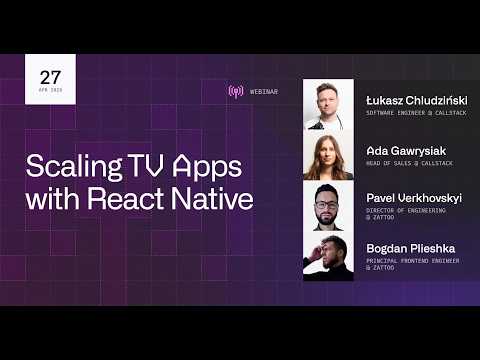
Zalando wanted to improve delivery speed and let teams build across platforms. Its existing Rendering Engine, a React framework already used on the web, offered reusable features such as data fetching and feature toggles. The team also considered Kotlin Multiplatform and native apps, but valued React Native’s fit with its existing React skills and framework.
Scaling React Native at Zalando: How Brownfield Migration Paid Off
Speakers
René Asam and Asam, software engineers at Zalando, discuss the company’s React Native brownfield migration with Callstack host Mike and engineers Mate and Jakob.
Zalando’s native apps had been in development for more than 10 years, so the team prepared research, documented tradeoffs, and used a proof of concept to make the case. The proof of concept took 1.5 full-time engineers over 15 days and demonstrated multiple screens with real data and observability. A brownfield rollout let Zalando test selected screens and traffic gradually, rather than replace the app all at once.
The first screen was chosen for low risk and low traffic, with feature toggles available to disable it if needed. Later screens tested demanding cases such as image and video content and long, scrolling lists. Zalando created a “meaningful render” metric for the time until key content appears, compared React Native screens with native versions, and checked business metrics through staged rollouts and A/B tests.
To keep the migration isolated from existing app dependencies, Zalando packaged React Native as a library consumed through native interfaces: an XCFramework on iOS and an AAR on Android. Dependency injection lets the host app provide services such as wishlist, cart, and authentication, avoiding duplicate implementations. The team also distributed a prebuilt app that connects to a local Metro bundler to make development easier.
The team reported around four screens fully rolled out, 12 in testing or monitoring, and seven code complete. Native engineers learned React Native and shipped important screens, including the home screen. Zalando aimed to bring around 90% of app traffic to React Native by early 2026, while focusing next on technical debt, observability, list performance, web interoperability, and community contributions.
Takeaways
- Reuse a proven internal framework to reduce the cost and uncertainty of adopting a new platform.
- Use a low-risk first screen to validate stability, then choose harder screens to test specific technical limits.
- Feature flags, market targeting, and staged traffic increases make large migrations easier to control.
- Define a user-visible performance measure that can be compared across implementations, then pair it with business metrics.
- Package cross-platform code behind clear native interfaces to limit coupling with existing app internals.
Mentioned in this talk


Search inside this talk
What was claimed 18
- uses
 Zalando uses React Native
“measuring performance with our brownfield approach for React Native”
0:06inPerformance Comparisons in Brownfield React Native ProjectsYouTube Verified3 sources· Talk
- ceo ofMike at Cole Stack CEO of
 CallstackCEO and founder
“I'm the CEO and founder”
YouTube Unverified1 source· Talk
- role at
“I'm Mate, a software engineer at Callstack.”
YouTube Unverified1 source· Talk
- role at
“I'm Jakob, a business manager at Callstack.”
YouTube Unverified1 source· Talk
- role at
“I'm René, a software engineer at Zalando.”
YouTube Unverified1 source· Talk
- role at
“I'm a senior principal software engineer at Zalando”
YouTube Unverified1 source· Talk
- metricZalando: Around 90 customer-facing app screens
“the main customer-facing application basically has almost 90 screens”
YouTube Unverified1 source· Talk
- metricZalando: Around 50 million customers in Europe
“more than 50 million customers around Europe”
YouTube Unverified1 source· Talk
- usesZalando uses rendering engine
“we had a web framework called Rendering Engine that we use internally”
YouTube Verified2 sources· Talk
- metricrendering engine: Running at Zalando since around 2018
“the rendering engine framework had been running at Zalando since around 2018”
YouTube Unverified1 source· Talk
- metricbrownfield development: POC took 1.5 full-time engineering effort over 15 days
“the whole POC took 1.5 full-time engineering effort over 15 days”
YouTube Unverified1 source· Talk
- featureZalando: Meaningful render metric measures time until first meaningful content appears
“It measures the time until the first meaningful content appears.”
YouTube Unverified1 source· Talk
- integrates with
“and an AAR for Android”
YouTube Unverified1 source· Talk
- integrates withZalando integrates with XCFramework
“packaging React Native neatly into native frameworks: an XCFramework for iOS”
YouTube Unverified1 source· Talk
- uses
“you're using StyleX for that”
YouTube Unverified1 source· Talk
- metricZalando: Around four screens fully rolled out; around 12 in testing or monitoring; around seven code complete
“around four screens have been fully rolled out”
YouTube Unverified1 source· Talk
- metricZalando: Targeting around 90% of app traffic on React Native by early 2026
“Early 2026, we will reach around 90% of the app's traffic on React Native.”
YouTube Unverified1 source· Talk
- uses
“we're doing tests in Appium”
YouTube Unverified1 source· Talk