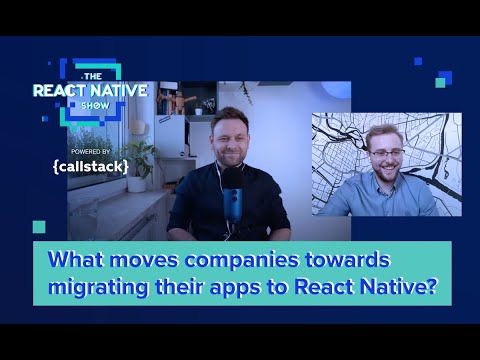
Mike groups migration reasons into addressing current problems and creating future benefits. Poor performance, technical debt, and difficult maintenance can justify a rebuild, while shared code across platforms may reduce development time and cost. He also points to developer experience and the option to expand a React app to mobile or desktop.
Migration to React Native
Speakers
Mike Hujak, Head of Delivery at Callstack, discusses migrating native and web apps to React Native with host Łukasz Kłudziński on the React Native Show podcast.
Mike recommends four phases: business evaluation, planning and preparation, implementation, and validation and rollout. Teams should assess their skills, target platforms, documentation, designs, user stories, and tests before estimating the work. He says defining key performance indicators and critical-to-quality factors helps track whether the new app meets business and user needs.
Brownfield development adds React Native to an existing native app, so teams can introduce features or replace parts gradually while continuing to ship and earn revenue. Mike says this work requires knowledge of React Native and native iOS and Android systems, especially when setting up the integration. To avoid slowing native developers with JavaScript tooling and longer builds, Callstack packaged React Native code and assets as native artifacts such as an AAR or XCFramework.
Mike says repeated integration work led Callstack to create React Native Brownfield, a library of helpers for embedding React Native views and coordinating native and JavaScript navigation. He describes plans for a command-line tool to build distributable artifacts and a generator for native components backed by React Native. The planned release was delayed while the team worked to support Fabric and Turbo Modules alongside the older architecture.
Mike distinguishes converting an existing React app to additional platforms from migrating a non-React web app to React. The effort depends on component modularity, platform-specific code, layout differences, and styling; React Native Web can help reuse React Native components on the web. He recommends breaking the interface into small components and composing them, and notes that CSS or SCSS-heavy projects may require substantial styling work.
Takeaways
- Assess the existing code, team skills, documentation, and target platforms before estimating a migration.
- Set measurable performance and quality goals before implementation so the team can evaluate the result.
- A brownfield rollout can add React Native features while the existing app continues to ship.
- Package React Native integration as a native artifact to reduce new tooling and build work for native teams.
- For cross-platform conversion, modular components help; the amount of styling work depends on the existing approach.
Mentioned in this talk


Search inside this talk
What was claimed 9
- role atMike Hujak is Head of Delivery at Callstack Team
“head of the delivery department at Callstack”
YouTube Unverified1 source· Talk
- featureReact Native Brownfield: Facilitates integrating React Native into native apps
“a set of tools to facilitate integrating React Native into native apps”
YouTube Unverified1 source· Talk
- built
“I created a library called React Native Brownfield”
YouTube Unverified2 sources· Talk
- launchedReact Native Brownfield: 2019
“React Native Brownfield was introduced in 2019”
YouTube Unverified1 source· Talk
- featureReact Native Brownfield: Planned generator for native components from annotated TypeScript React Native components
“a generator for native components”
YouTube Unverified1 source· Talk
- featureReact Native Brownfield: Planned CLI to build and publish a native artifact
“we'll provide a CLI that lets you build an artifact with one command”
YouTube Unverified1 source· Talk
- integrates withReact Native Brownfield integrates with Fabric
“We'll support Turbo Modules and the Fabric renderer”
YouTube Unverified1 source· Talk
- integrates withReact Native Brownfield integrates with TurboModules
“We'll support Turbo Modules and the Fabric renderer”
YouTube Unverified1 source· Talk