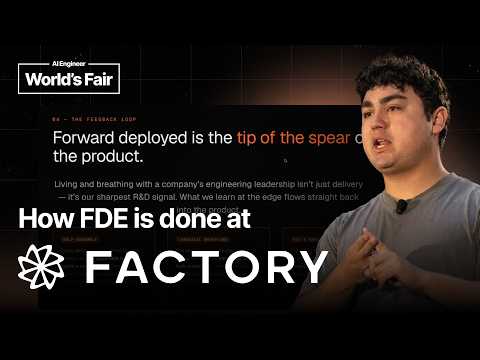
Reyes says Factory has spent about two and a half years building Droid for organizations that need enterprise controls. Alongside terminal, IDE, web, and desktop interfaces, Factory offers codebase analysis, ROI analytics, and controls for managing agent use.
Full Tutorial: The Most Underrated AI Agent for Coding and Product Work
#Coding Agents#AI-Assisted Development#Evals#AI Adoption#Workflow Automation#Developer Tools#Product Management
Speaker
Eno Reyes, co-founder of Factory, explains how the company’s Droid coding agent supports software development and broader product work in a conversation with Peter Yang on the Peter Yang channel.
Reyes uses notes from a Granola conversation as input for a speed-reading web app. In Spec Mode, Droid asks what the app should do, creates a specification document, and uses that spec to guide implementation. Reyes says users can change autonomy, models, and modes during a session.
Reyes argues that agents are limited by how well they check their own output. Droid runs builds, linters, and type checks, and uses browser screenshots and interactions to review the app. The demo also shows Droid adapting the app to Factory’s existing colors, components, and fonts by reading the codebase.
Reyes describes skills, MCP, hooks, and shared configuration as ways to customize agent workflows. His product management skill draws on Factory’s product principles, positioning, prioritization frameworks, and templates, including documents in Notion. He says this context helps produce PRDs and design documents that reflect the company’s established language and practices.
Reyes says Factory mainly hires product engineers, while employees in roles such as sales also use Droid for customer research, usage analysis, and deal tracking. He describes enterprise customers expanding access beyond software engineers so teams like product, operations, QA, and data science can ask questions about codebases. Factory focuses on difficult enterprise code problems, including legacy systems and refactoring.
Takeaways
- Give an agent a clear specification of what to build, and let it determine the implementation steps.
- Make validation part of the agent workflow with builds, tests, type checks, and browser review.
- Ground agent output in existing code, design patterns, and company source documents.
- Use skills to package repeatable workflows and organizational context for teams.
- Consider read access to codebases for colleagues involved in software delivery, even when they do not write code.
Mentioned in this talk


Search inside this talk
What was claimed 10
- built
“we build products called droids”
0:13inBuilding Reliable Agentic SystemsYouTube Verified5 sources· Talk, Web· archived
- foundedCo-founder
“My guest today is Eno Reyes, co-founder of Factory”
YouTube Verified4 sources· Talk, Web· archived
- feature
 Droid: Provides company codebase analysis, ROI analytics, and enterprise controls
“We give you ROI analytics and enterprise controls.”
YouTube Unverified1 source· Talk
- featureDroid: Works across terminal, IDE, web, and desktop surfaces
“Our product doesn't stop at the terminal, IDE, web, or desktop.”
YouTube Unverified1 source· Talk
- featureDroid: Supports multiple frontier models and configurable autonomy levels
“we support nearly every frontier model, as well as different levels of what we call autonomy”
YouTube Unverified1 source· Talk
- featureDroid: Can use Chrome DevTools to browse, interact with, and QA work
“This is using Chrome DevTools”
YouTube Unverified1 source· Talk
- integrates with
“Factory has a native Notion integration”
YouTube Unverified1 source· Talk
- metricFactory: 40 employees
“We're 40.”
YouTube Unverified1 source· Talk
- metricDroid: Number one on Terminal-Bench, according to the host
“you guys are number one on Terminal-Bench”
YouTube Unverified1 source· Talk
- metricFactory: Deployed at a customer and expanded from zero to 10,000 people in a couple of months
“We deployed at a customer and went from zero to 10,000 people in a couple of months.”
YouTube Unverified1 source· Talk