Shun describes Hermes as a JavaScript engine designed for React Native, with a focus on time to interactive, app size, and memory use. Facebook measurements cited in the episode show startup time and APK size roughly halved, with memory use reduced by about one-third to one-quarter.
React Native 0.64 with Hermes for iOS
Speakers
Host Mike, Shun from Facebook’s Hermes team, and Alloy Brand from Microsoft discuss Hermes and its new iOS support in React Native 0.64 on Callstack’s React Native Show.
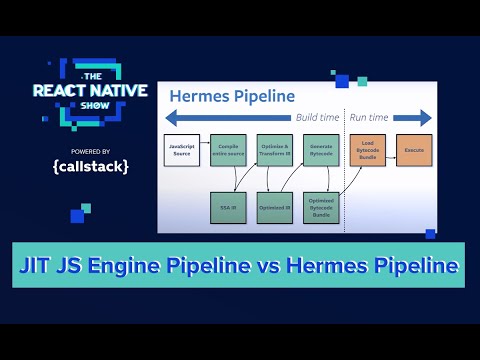
Hermes compiles JavaScript into optimized bytecode during the app build, so the device can load it without parsing and compiling the source at startup. Shun explains that AOT describes when compilation happens, not whether the output is native machine code. He says React Native’s bundled code and interaction-driven workload make this approach useful: many functions run only once or not at all during startup.
Shun says Hermes is still adding JavaScript features and improving garbage collection, memory use, and tooling. He describes work on shorter GC pauses, 32-bit values with pointer compression, and inline storage for small arrays. The guests also discuss community blockers: proxy support became the default in React Native 0.64, while Android internationalization support was planned for 0.65.
Alloy explains that Microsoft wanted a shared, adaptable engine for React Native across platforms, with consistent debugging and tooling. He says Hermes lets Microsoft address React Native-specific needs, including debugging around synchronous native calls. The discussion also notes that Hermes may improve startup and memory behavior on iOS, while JavaScriptCore can remain a better fit for apps prioritizing current app size.
Alloy argues that Hermes avoids the JIT behavior Apple has restricted: compiling code to native machine code in memory and marking it executable. The episode presents Hermes support for iOS and macOS as available work, while treating future default adoption across platforms as uncertain. Mike points listeners to an accompanying article for implementation details and setup.
Takeaways
- Measure time to interactive, memory, and download size separately when evaluating a JavaScript engine.
- AOT means compilation happens before runtime; it does not necessarily mean compilation to native code.
- React Native’s bundled, interaction-driven workload can make startup-focused bytecode precompilation a practical fit.
- A shared engine can reduce duplicated debugging and tooling work across platforms.
- Check platform-specific needs, including internationalization and app size, before switching engines.
Mentioned in this talk


Search inside this talk
What was claimed 10
- integrates with
 Hermes Agent integrates with React Native Framework
“with Hermes in React Native”
0:00inJIT JS engine pipeline vs Hermes pipelineYouTube Verified2 sources· Talk
- built
 Meta built Hermes Agent
“Hermes is a new JavaScript engine built by Facebook.”
0:16inIntroduction to Hermes EngineYouTube Verified3 sources· Talk
- previously atAlloy Brand previously at
 MicrosoftReact Native in Office team
“having joined to work on React Native in Office. Since then, I’ve moved to a different team”
YouTube Unverified1 source· Talk
- works atAlloy Brand works atMicrosoft
“I’ve been working remotely for Microsoft for a year”
YouTube Unverified1 source· Talk
- role at
“I’m a software engineer at Facebook, working on the Hermes JavaScript engine.”
YouTube Unverified1 source· Talk
- builtMicrosoft built Hermes AgentNode-API support
“Microsoft has contributed to Hermes.”
6:01inHermes RoadmapYouTube Verified3 sources· Talk
- metricHermes Agent: Facebook data showed time to interactive cut in half, APK size roughly cut in half, and memory reduced by about one-third to one-quarter
“time to interactive is cut in half, APK size is roughly cut in half as well, and memory is reduced by about one-third to one-quarter”
YouTube Unverified1 source· Talk
- featureHermes Agent: Compiles JavaScript source to optimized bytecode ahead of time
“Hermes can compile your JavaScript source code to optimized bytecode ahead of time”
YouTube Unverified1 source· Talk
Related talks
 11:14
JIT JS engine pipeline vs Hermes pipeline
Jun 30, 2021
 12:21
 5:15
 24:39
 23:47
 12:06
Hermes Roadmap
Jul 1, 2021