Ryan describes the traditional path from request and triage through design, build, review, and QA. He argues teams can shorten that cycle by having people and bots collaborate in the same thread. In one example, a bug report was reviewed, reproduced, and refined with a designer before it was merged about an hour and a half after the report.
Ship Code at Scale with Grok Bot and Cursor
Speakers
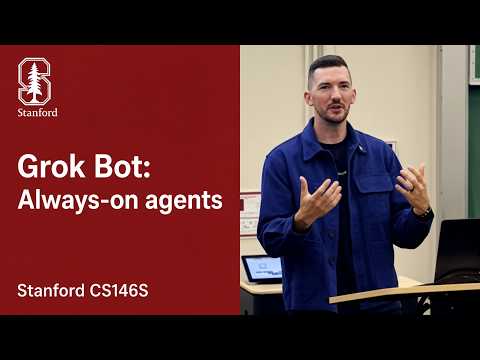
Ryan, a senior field engineer at SpaceX, explains how his team uses Grok Bot and Cursor to coordinate engineering work with Zoe Barns and the audience.
Ryan says bots can capture practical guidance such as how to reproduce bugs and what counts as done. Teams can add skills and guardrails when a bot misses something, such as checking both light and dark modes. He recommends starting with exploratory personal bots, sharing useful ones as team bots, and adding more structure as trust grows.
Ryan demonstrates long-lived bots with their own browser, connections, memory, and skills. His Grafana reproduction bot initially tried the public site, so he taught it to work locally and use a prepared cloud agent environment. He then shared the bot with the team so others could reproduce issues across eight repositories.
Ryan recommends the Bot Development Kit for tasks that need deterministic behavior, versioning, or evaluations, such as routing incoming issues to the right repository. He shows routing and reproduction agents working together, with an evaluation suite that passed 48 of 50 cases. The BDK also provides deployment, logs, metrics, traces, and integrations with tools such as Slack.
The hosts describe a progression from personal experiments to shared team bots and, when useful, coded agents with verification. Ryan points to settings for controlling computer access, sharing, network egress, and permitted MCP connections. As an example of a larger feedback loop, he describes bots that help build and operate a mobile game, including creating ads and responding to app store issues.
Takeaways
- Put the request, bot work, and human feedback in one thread to reduce handoffs.
- When a bot misses a repeatable requirement, add it as a skill or guardrail.
- Share a successful personal bot with the team before investing in a coded agent.
- Use BDK evaluations when routing or another workflow needs measurable, repeatable behavior.
- Start with narrow permissions and expand access to tools and network destinations as needed.
Mentioned in this talk


Search inside this talk
What was claimed 15
- role at
“I’m from our superintelligence deployment team here at SpaceX SI.”
YouTube Unverified1 source· Talk
- role at
“I’m a senior field engineer here at SpaceX.”
YouTube Unverified1 source· Talk
- integrates with
“we have this view in both Slack and soon Microsoft Teams”
5:03inGrok Bot for AdminsYouTube Verified5 sources· Talk
- integrates with
“It'll triage Slack reports and Linear bugs”
YouTube Verified2 sources· Talk
- metric
 Grokbot: 214 reports per day in the example workload
“if we're getting 214 of these a day”
YouTube Unverified1 source· Talk
- integrates with
“I want to connect to GitHub first.”
YouTube Unverified1 source· Talk
- featureGrokbot: Persistent bots can retain memories and skills and can be given routines
“They're actual entities. They're long-lived”
YouTube Unverified1 source· Talk
- featureGrokbot: Bots have a cloud computer with a browser that a person or bot can control
“they have a computer. This is just a browser in the cloud”
YouTube Unverified1 source· Talk