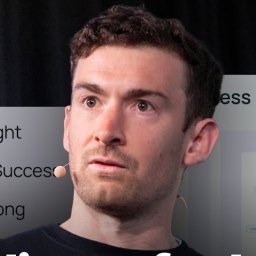
Joseph introduces bots that can run routines, use specialized skills, and work as teammates. He shows how Martin’s shared designer bot Dex can be added to group chats, where people and bots collaborate. The team’s example is a sticker shop built around designs from Grok Bot 101.
Grok Bot 201
#AI Agents#Coding Agents#Multi-Agent Systems#Product-Market Fit#Workflow Automation#Agent Infrastructure#AI Benchmarks#Human-in-the-Loop Systems
Speakers
Joseph, a field engineer at SpaceX AI, presents Grok Bot 201 with Scott Lerner, showing how teams can build, share, and coordinate bots through a sticker shop project.
Joseph creates a UI/UX designer bot and asks it to use Duolingo’s store as inspiration. He demonstrates sending the same brief to three Cursor Cloud Agents using different models, then discusses how separate design and development bots keep their own context and responsibilities. A voice conversation with the full-stack bot helps settle on a simple Next.js mockup without a database or payment system.
Joseph introduces Ed, a metrics bot that reads sticker page views from Vercel, and Roy, a primary bot that coordinates the work. In the proposed 24-hour routine, Roy uses Ed’s analytics to identify three low-performing stickers, asks Dex for replacements, and has Lou update the website. Joseph notes that people refined the workflow and that human oversight remains useful.
Scott recaps bot personas, memory, skills, routines, Cursor Cloud Agents, and shared team bots. The Q&A covers voice interaction, a newly released bot email feature, and how to use model fan-out: first refine a prompt with a familiar model, then compare outputs from others. The presenters say the session materials will be shared through their workshops.
Takeaways
- Give bots distinct roles and context so each can focus on a specific part of a workflow.
- Share a well-configured team bot so colleagues can use its skills and benefit from its updates.
- Test several models on the same brief when comparing design approaches, after clarifying the task with a model you know.
- Use product metrics to guide iteration, and keep human review in the loop while refining automated routines.
- State preferences and constraints early, such as budget limits or the desired level of infrastructure.
Mentioned in this talk





Search inside this talk
What was claimed 19
- role atScott Lerner is AI deployment team member at X
“I'm on our AI deployment team here at SpaceX AI.”
YouTube Unverified1 source· Talk
- role at
“I'm on the SpaceX AI field engineering team.”
YouTube Unverified1 source· Talk
- feature
 Grokbot: Bots have their own memory, skills, routines, and persona; shared bots can be managed by their creator and used by teammates.
“bots actually have their own memory”
YouTube Unverified1 source· Talk
- uses
“grabs all the assets from Figma”
YouTube Unverified1 source· Talk
- built
“Dex. It's a designer. It grabs all the assets from Figma and turns them into more creative assets”
YouTube Unverified1 source· Talk
- uses
“Let's use Gemini as well. Gemini 3.7 is pretty good, too.”
YouTube Unverified1 source· Talk
- uses
“I think Opus 5.5 is a fan favorite”
YouTube Unverified1 source· Talk
- uses
“The three models I want are, of course, Grok 4.7.”
YouTube Unverified1 source· Talk