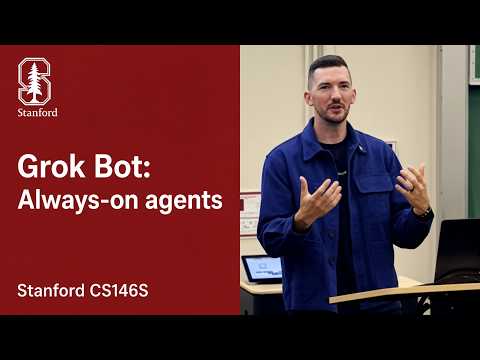
Peng Zheng organizes bots around work and life, with a Chief of Staff to route tasks, plus Writer and Designer bots. He describes using them to research and list a microphone for sale, manage inbox actions, update a calendar, and turn articles into audio. For larger tasks, separate bots can contribute in a group chat while keeping their own roles and context.
We Built Grok Bot. Here Are Our 14 Best Bots
#Agent Memory#Multi-Agent Systems#Coding Agents#Developer Tools#Workflow Automation#Human-in-the-Loop Systems#Evals
Speakers
Peter Yang talks with Peng Zheng and Lauren Tan, who describe their design and engineering work on Grokbot at xAI and show how they use named bots for work and personal tasks.
Lauren Tan uses a Designer bot connected to Figma and configured with her design system, including its colors, typography, and spacing. She creates a key frame or initial system, then asks the bot to expand it into a full flow. For engineering work, she has Grokbot control a Linux virtual machine and verify changes on her computer.
Lauren describes an evaluation playbook for her plugin stack that has agents test changes before a pull request lands. Her engineering lead bot breaks work into smaller tasks and delegates to cloud agents, while other bots gather social media mentions and bug reports. Shared skills can be used across Grokbot and Cursor.
Peng says his assistant booked a multi-stop work trip after he reviewed and approved the proposed flights and hotels. The guests recommend observing an agent, correcting its work, and turning a successful process into a reusable skill. Lauren suggests starting with simple tasks, then adding recurring routines and more autonomy as confidence grows.
Peng describes a progression from people doing tasks themselves, to prompting AI, to designing guardrails for agents that work together. He says named bots with roles and memory can make the system easier to understand than model-focused concepts. Their goal is to connect tools, people, and bots so workflows can continue with less manual coordination.
Takeaways
- Start by giving a bot a simple task, then expand its responsibility as it proves reliable.
- Review and correct an agent’s work before turning the process into a reusable skill.
- Use separate bots for reusable roles, then give projects their own chats and context.
- Ask agents to verify their work, and use evaluations before allowing changes to land.
- Keep human approval for consequential actions, such as booking travel.
Mentioned in this talk


Search inside this talk
What was claimed 11
- role atPeng Zheng is design and technical staff member at
 Grokbot
“members of the design and technical staff on the Grokbot team”
YouTube Unverified1 source· Talk
- featureGrokbot: Supports persistent named bots with their own identities, memory, and tools, plus separate and group chats
“persistent, named agents that have their own identity, memory system, and tools”
YouTube Unverified1 source· Talk
- integrates with
“it connects to Figma through the Figma MCP connector”
YouTube Unverified1 source· Talk
- role atLauren Tan role at
 xAI
“At xAI, we design in whatever tools we need.”
YouTube Unverified1 source· Talk
- usesLauren Tan uses
 Omarchy
“I've been using Grok Bot to essentially control this special build of Omarchy”
YouTube Unverified1 source· Talk
- featurePstack: Includes an evaluation playbook that checks whether changes achieve their intended goals before a pull request lands
“Only if they are does it land the pull request.”
YouTube Unverified1 source· Talk
- usesLauren Tan usesCursor
“I kick off Cursor Cloud Agents”
YouTube Unverified1 source· Talk
- usesPeng Zheng uses Tuki
“I’ve booked my upcoming trip through Tuki.”
YouTube Unverified1 source· Talk