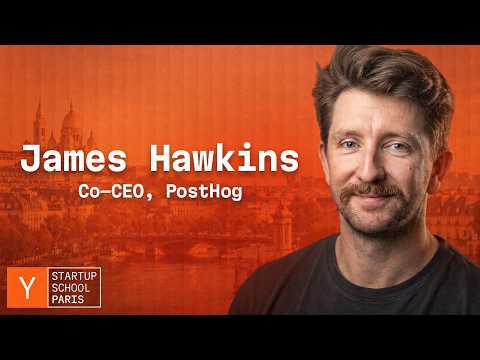
PostHog’s first successful product was self-hosted, open-source product analytics. The founders wanted engineers to query their own data and keep it in their infrastructure, and they saw teams maintaining their own unreliable analytics systems. Earlier attempts included a sales territory tool, which got 15 verbal expressions of interest but no account signups.
From Pivot Hell To $1.4 Billion Unicorn
Speaker
James Hawkins, co-founder and CEO of PostHog, talks with a Y Combinator host about the company’s pivots, growth, fundraising, product strategy, and marketing.
The founders worked hard on each idea, including traveling to meet interested customers, and used failed sales to recognize when a product was only a nice-to-have. Open-source analytics excited them more than earlier ideas, and a Hacker News launch brought an initial audience. Hawkins says doing the work gave them clearer signals than waiting for inspiration.
PostHog began raising in March 2020, when COVID caused investors to pull back; the founders accepted $5,000 angel checks before securing a round. Hawkins says they improved their pitch by clearly committing to growing the open-source community instead of offering a generic spending plan. Years later, the company raised $75 million to pursue a broader product strategy, including software that could use customer data to identify issues and propose pull requests.
Hawkins says PostHog built trust by explaining its business, plans, and people publicly, including sharing the founders’ experience moving to San Francisco. Its billboards use humor and unusual imagery to win attention rather than drive immediate conversions. A small group reviews the work, with a practical test: whether they would find it funny themselves.
PostHog invested heavily in its website because self-serve customers use it to understand the company and its products. The site includes extensive product information, a developer jobs board, a public handbook, and a newsletter with more than 100,000 subscribers. Hawkins says the unusual, detailed experience was designed to reflect the company and attract its audience; the host reports that conversion did not collapse and later improved alongside traffic.
Takeaways
- Use customer behavior, such as whether prospects create an account or pay, to test interest rather than relying on friendly feedback.
- Commit fully to an idea long enough to learn from it, then use the evidence to decide whether to continue.
- When fundraising, explain a specific plan you believe in and why it matters to the company.
- Build trust by making the people, plans, and tradeoffs behind a product easy to understand.
- For awareness marketing, make work distinctive enough to earn attention from people beyond your immediate industry.
Mentioned in this talk


Search inside this talk
What was claimed 17
- builtIntercom built Intercom Fin
“It launched the day GPT-4 came out”
1:35inHow Building with AI Can Double the Throughput of Your Engineering TeamYouTube Verified6 sources· Talk, Web, Job posting· archived
- foundedJames Hawkins founded
 PostHogCo-founder
“James Hawkins, CEO and founder of PostHog”
YouTube Verified3 sources· Talk, Web· archived
- metricPostHog: Raised $75 million at a $1.4 billion valuation
“raising a $75 million Series Z round of funding at a $1.4 billion valuation”
YouTube Unverified1 source· Talk
- role atJames Hawkins is CEO atPostHog
“James Hawkins, CEO and founder of PostHog”
YouTube Unverified1 source· Talk
- ceo ofJames Hawkins CEO ofPostHogCEO
“James Hawkins, CEO and founder of PostHog”
YouTube Unverified1 source· Talk
- role at
 Y Combinator is Winter 2020 batch at PostHog
“PostHog from the YC Winter 2020 batch”
YouTube Unverified1 source· Talk
- featurePostHog: Keeps customer and product data in one stack
“keep all their customer and product data in one stack”
YouTube Unverified1 source· Talk
- featurePostHog: Helps users debug their product and ship features faster through feature flags
“We help users debug their product and ship features faster through things like feature flags.”
YouTube Unverified1 source· Talk