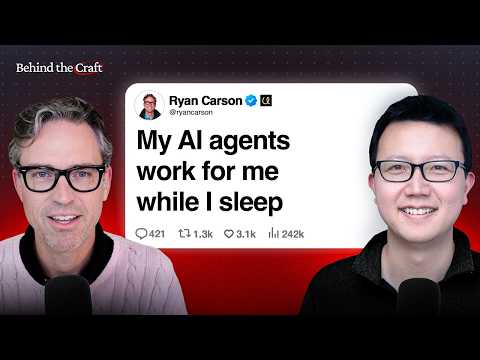
Carson uses a Markdown prompt to have an AI ask clarifying questions, then produce a product requirements document. He demonstrates it with a proposed onboarding feature for Untangle, an app that helps people through divorce. The questions and PRD give the agent context before implementation begins.
A Proven 3-File System to Vibe Code Production Apps
Speakers
Ryan Carson, a serial founder building Untangle and working with AMP, walks Peter Yang through a three-file system for planning and implementing AI-assisted features, then discusses solo founding and choosing a painful problem to solve.
A second prompt turns the PRD into a small set of parent tasks, which Carson reviews before asking for detailed subtasks. He adds creating a feature branch and asks for tests at each step. He also uses a more capable reasoning model, the Oracle, to check whether the plan is missing larger tasks.
The third prompt tells the agent to handle one subtask at a time, wait for approval to continue, mark completed work, and run tests before committing. Carson demonstrates the workflow with a relationship assessment feature, including a static UI mockup so he can review the design before investing further in implementation. He says this close supervision may be less necessary as models improve.
Carson describes Untangle as a Connecticut-focused divorce app, because the state has 14 forms with 277 fields and divorce rules vary by state. His sisters’ experiences led him to the problem, which he says could reduce the cost of a process that may otherwise cost $15,000 to $40,000. He contrasts this urgent need with Treehouse, which taught about a million people to code but addressed a less immediate need.
Carson says running a company with more than 100 employees took him away from hands-on building, while working solo on Untangle lets him ship and control his time. He argues that a small, cash-flowing business can support a good life without venture funding or a large team. He also suggests learners can use AI as a tutor while building projects they care about.
Takeaways
- Give an agent context through clarifying questions and a written PRD before asking it to build a substantial feature.
- Review a short list of parent tasks before expanding it into subtasks.
- Use tests as feedback for the agent, and keep implementation steps small enough to review.
- Preview a static UI early to catch misunderstandings before building functionality around it.
- Look for urgent problems people already feel, and choose a company size that fits the life you want.
Mentioned in this talk


Search inside this talk
What was claimed 13
- foundedRyan Carson founded
 TreehouseFounder, CEO
“That's where Treehouse was born”
YouTube Verified2 sources· Talk, Web· archived
- acquiredDropSend: Acquired after about two years
“it was acquired after about two years”
YouTube Unverified1 source· Talk
- builtRyan Carson built DropSend
“I basically built Dropbox. It was called DropSend. I built it myself”
YouTube Unverified1 source· Talk
- metricTreehouse: Taught about a million people how to code
“We taught about a million people how to code”
YouTube Unverified1 source· Talk
- usesRyan Carson uses
 Ghosttyterminal for his coding workflow
“I'm a big fan of Ghostty”
YouTube Unverified1 source· Talk
- usesRyan Carson uses
 Ampcoding agent of choice
“On the right, I have one pane where I'm going to run Amp”
YouTube Unverified1 source· Talk
- usesRyan Carson uses Whisper Flowspeaks most prompts
“I'm also a big fan of Whisper Flow, so I talk most of my prompts”
YouTube Verified2 sources· Talk
- usesAmp uses
 Gemini Flashsome summarization tasks
“We also use Gemini Flash for some summarization tasks”
YouTube Unverified1 source· Talk