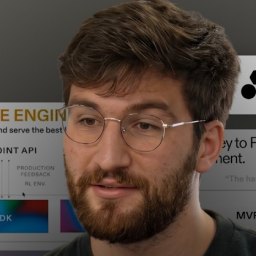
Joseph describes pretraining as learning to predict the next word across large text datasets, producing a training signal at every token. He says scaling compute, data, and model size has reliably reduced prediction loss. Autoregressive models also have a practical advantage: they can generate open-ended text that can be used in products.
Anthropic Head of Pretraining on Scaling Laws, Compute, and the Future of AI
#Model Training#Cloud Infrastructure#Data Quality#Synthetic Data#Evals#Reinforcement Learning#Inference Infrastructure#AI Application Development
Speaker
Nick Joseph, head of pretraining at Anthropic, joins Y Combinator to discuss how scaling laws, compute, data, and engineering shape AI models.
Choosing model dimensions and parallelism means balancing hundreds of hyperparameters, so teams test scaled-down versions before committing to expensive runs. In Anthropic’s early work, the team built and modified distributed training tools and profiled jobs across hundreds or thousands of GPUs. Joseph says hardware can fail in unexpected ways, and a subtle bug can waste months of training.
Joseph says it is unclear how much useful internet data remains, since usefulness depends on the model and cannot be counted easily. Training on a model’s own outputs may reproduce its errors, though AI-generated material online is not automatically harmful. He favors evaluations that measure meaningful capabilities, produce low-noise results, and run quickly; he also says next-token loss can be a useful signal.
Joseph defines alignment as making models share human goals and behave as intended. He sees post-training as easier to iterate on because teams can test changes in hours or days, while pretraining runs take months. Some alignment methods might eventually move into pretraining for greater robustness, but doing so can make later behavior changes harder.
Joseph expects further shifts in training methods, including more reinforcement learning, while saying scale and careful experimentation remain important. He emphasizes engineering depth, from model behavior down to GPUs and network protocols, and close coordination with inference teams so models can run efficiently. For students, he recommends building engineering skills and thinking about how to use AGI well.
Takeaways
- Use smaller, proportionally scaled runs to check assumptions before committing to a large training job.
- Treat profiling and debugging as core parts of model training, including checks for hardware faults.
- Choose evaluations that track capabilities you care about and provide low-noise, actionable results.
- Coordinate pretraining choices with inference teams because model design affects serving cost and speed.
- Build deep engineering skills and keep a clear view of how advanced AI could benefit people.
Mentioned in this talk


Search inside this talk
What was claimed 14
- built
“they'd fine-tuned GPT-3 to write code.”
YouTube Verified4 sources· Talk, GitHub, Web· archived
- role atNick Joseph is Head of pretraining at
 Anthropic
“Nick Joseph, the head of pretraining at Anthropic.”
YouTube Unverified1 source· Talk
- uses
“working with security teams and Claude to find and fix vulnerabilities”
0:12inUsing LLMs to Secure Source CodeYouTube Verified8 sources· Talk
- featureVicarious: Shifted toward robotics products
“they were shifting toward products, particularly robotics products.”
YouTube Unverified1 source· Talk
- previously atNick Joseph previously at
 OpenAI
“and then at OpenAI before Anthropic.”
YouTube Unverified1 source· Talk
- previously atNick Joseph previously at Vicarious
“I was at Vicarious”
YouTube Unverified1 source· Talk
- role atNick Joseph is Worked on a safety team and code models atOpenAI
“I was on one of the safety teams. I ended up working on code models.”
YouTube Unverified1 source· Talk
- uses
“take some text and predict the next word.”
YouTube Unverified1 source· Talk
- featureScaling laws: More compute, data, and parameters predictably lower training loss
“putting in more compute, more data, and more parameters gives you a lower loss”
YouTube Unverified1 source· Talk
- usesNick Joseph uses PyTorch
“I was mostly operating at the level of, like, torch.matmul”
YouTube Unverified1 source· Talk
- uses
“Thousands.”
YouTube Verified2 sources· Talk
- featureReinforcement learning: Additional compute can produce better models
“you put more and more compute into RL, and you can get better and better models out of that.”
YouTube Unverified1 source· Talk
- featurepretraining: Uses most of the compute in the earlier training paradigm
“you just do a lot of pre-training; you use most of your compute.”
YouTube Unverified1 source· Talk
- feature
 Claude: Claude Sonnet 4 and Claude Opus 4 are models at Anthropic's current scale
“The models everyone uses, like Claude Sonnet 4 and Claude Opus 4, are our first shot at models at that scale.”
YouTube Unverified1 source· Talk