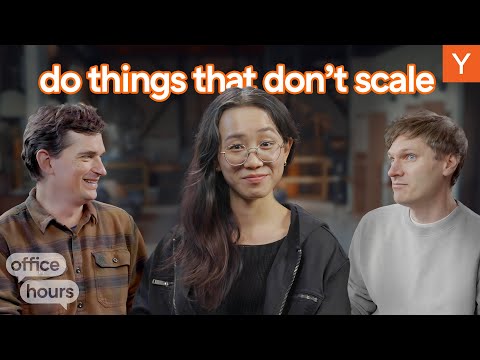
Buchheit says startups often need ideas that established companies would dismiss as too small, strange, or risky. He points to Google, which Larry Page and Sergey Brin tried to sell for $1 million before its potential was clear. He also describes joining Google because he used its search product and was excited about its Linux infrastructure, not because he expected a big return.
Startup Investor School Day 2
Speaker
Paul Buchheit, Y Combinator partner and Gmail inventor, shares lessons from his startup investing at Startup Investor School Day 2 with the Y Combinator audience.
Buchheit says he looks for founders who are better than he is and can explain their ideas clearly. Meraki built and sold mesh Wi-Fi hardware without raising money, while Kyle Vogt built a streaming server over a weekend that helped Justin.tv survive. He also highlights Blake Scholl’s clear explanation of how his supersonic jet company would address problems that doomed the Concorde.
Buchheit missed an opportunity to invest in Dropbox after canceling a meeting with Drew Houston, and moved too slowly on Airbnb before it signed a term sheet with Sequoia. He says investors should make deliberate decisions, since promising companies may not wait. He also warns that a low valuation, sympathy for founders, cynical ideas, or impressive numbers alone have not led to good returns for him.
Buchheit looks for clear communication, fast execution, resourcefulness, ambitious or playful ideas, the ability to attract talent, a product people want, and determination. He suggests asking what founders accomplished in the past month and looking for a rising trajectory, even when current numbers are small. He also advises probing for commitment and learning how founders respond to setbacks.
Buchheit says seed investing involves substantial luck, so investors should not build elaborate theories from every win or loss. He relies on founders’ expertise when evaluating unfamiliar fields, including deep technology and biotech, where demand may be clear but technical success is uncertain. He warns that abundant funding can shield founders from customers and reality, and says investors need to balance learning from past mistakes with staying open to new opportunities.
Takeaways
- Look for founders who explain complex ideas clearly and can show what they have accomplished recently.
- Favor teams that test ideas quickly and make meaningful progress with limited resources.
- Move decisively when a company looks promising; delay can mean losing access to it.
- Assess whether a product creates real value, rather than relying on price, traction, or a compelling story alone.
- Treat outcomes as partly shaped by luck, and avoid turning one failure into a rule against an entire category.
Mentioned in this talk



Search inside this talk
What was claimed 15
- acquired
 Meta acquired
 FriendFeed
“your company got acquired by Facebook”
6:04inScaling GrowthYouTube Verified4 sources· Talk, Web, Hacker News· archived
- acquired
“Twitch and was sold to Amazon”
0:00inWorking at Big Tech Companies Can Be a TrapYouTube Verified3 sources· Talk
- foundedCo-founder
“They are both co-founders of Cruise.”
7:17inWork at a Startup Expo 2018YouTube Verified4 sources· Talk, Web· archived
- foundedPaul Buchheit foundedFriendFeed
“that leads me to FriendFeed”
YouTube Verified2 sources· Talk, Web· archived
- builtPaul Buchheit built
 Gmailcreator, original lead developer
“he's known as the inventor of Gmail”
0:03inPaul BuchheitYouTube Verified11 sources· Talk, Web· archived
- role atPaul Buchheit is partner at
 Y Combinator
“is also a Y Combinator partner”
0:07inChoosing a Startup to Work AtYouTube Verified7 sources· Talk
- invested inPaul Buchheit invested in Wufoofirst angel investment
“My very first angel investment was in a YC company called Wufoo.”
YouTube Unverified1 source· Talk
- acquired
 SurveyMonkey acquired Wufooabout 44x return for Buchheit's investment
“my investment returned about 44x when SurveyMonkey bought them”
YouTube Unverified1 source· Talk