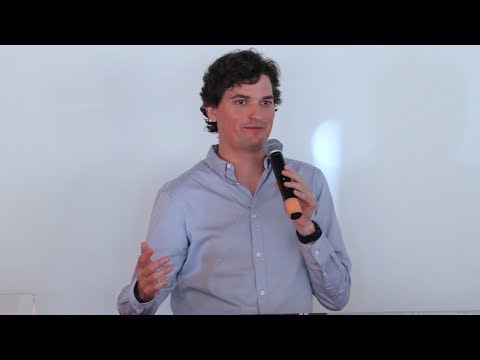
Ralston says fundraising is an uneven process and founders should expect rejection. He recommends clarifying why the company will matter, researching suitable investors, organizing outreach, and improving the pitch through repeated meetings.
Fundraising Fundamentals
Speaker
Geoff Ralston of Y Combinator gives founders a high-level guide to fundraising, from shaping a company story and finding investors to choosing terms and getting back to building.
Ralston explains that startups often raise money to hire and grow, though bootstrapping is possible. He advises raising when the company has options, planning for enough runway to reach profitability or persuasive milestones, and calculating expected hiring costs. For a seed round, he gives 18 months as a common planning horizon.
Investors assess both the founders and the opportunity: the product, customers, market size, traction, and ability to execute. Ralston says a compelling story can help even before traction, but founders should be honest about current facts and make future ambitions believable. He also cautions that an overly high valuation can derail fundraising, while an overly low one can cause unnecessary dilution.
Ralston describes convertibles as relatively fast and simple, while equity rounds involve more paperwork and investor rights. He explains that a post-money SAFE makes ownership easier to estimate, using $1 million on a $4 million post-money SAFE as roughly 25%. For investor meetings, he recommends doing research, keeping the pitch simple, bringing a demo or prototype, listening, and improving from feedback.
Ralston advises understanding an investor’s priorities during negotiations, keeping options where possible, and reading every document. He warns against exaggerating, breaking deals, or spending company funds carelessly. Fundraising is a step toward building a sustainable business, not a competition to raise the most at the highest valuation.
Takeaways
- Plan a raise around specific milestones, hiring needs, and runway.
- Research investors and tailor a clear, concise story to what they care about.
- Use each investor meeting to listen, gather feedback, and improve the pitch.
- Read fundraising documents carefully and be candid about the company’s facts.
- Once the money is in, focus on building a product customers want.
Mentioned in this talk


Search inside this talk
What was claimed 8
- role atAndy Bromberg is president at CoinList
“the president and co-founder of CoinList”
0:00inA Conversation About Crypto-currencies and ICOsYouTube Verified2 sources· Talk
- metric
 HP: Started in 1957 with $583 of the founders’ own money and never raised venture capital
“They started with $583 of their own money and never raised venture capital”
YouTube Unverified1 source· Talk
- invested inGeorges Doriot invested in Digital Equipment Corporation$70,000
“investing $70,000 in what was to become the epic company Digital Equipment Corporation”
YouTube Unverified1 source· Talk
- builtGeoff Ralston built AngelCalc
“I actually wrote a tool called AngelCalc”
YouTube Unverified1 source· Talk
- featureCoinList: Helps companies do ICOs
“CoinList, which helps companies do ICOs”
YouTube Unverified1 source· Talk
- metric
 Dropbox: Raised its first round at a $2–3 million valuation
“Dropbox raised their first round at a two- or three-million-dollar valuation”
YouTube Unverified1 source· Talk
- metric
 Y Combinator: $150,000 for 7% on a post-money SAFE
“$150,000 for 7% on a post-money SAFE”
YouTube Unverified1 source· Talk
- usesY Combinator uses
 SAFE
“our investments are going to be entirely on a post-money SAFE”
YouTube Unverified1 source· Talk