Wen describes a flexible workday spent across several projects, often reviewing working prototypes with engineers and product teammates. She still uses Figma for polish, but specs and planning documents are usually brief, with prioritization captured in a few bullet points.
Claude Cowork Tutorial from Cowork's Design Lead
Speaker
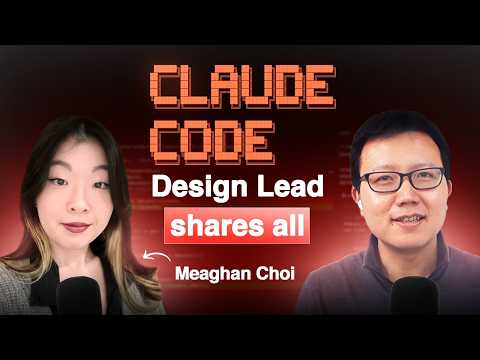
Jenny Wen, design lead at Anthropic, shows Peter Yang how she uses Claude Cowork and Claude Code and discusses Cowork’s design, development, and changing work practices.
Wen uses Cowork for most tasks, reserving Claude Code for detailed production code work. She demonstrates gathering themes from interview transcripts, social media, Reddit, and reviews, then producing a presentation and feature ideas in parallel. She suggests scheduling this process for Mondays at 10 a.m. to help the team start the week with insights and options.
Wen asks Cowork to draft wireframe options for a step-by-step progress interface, then describes taking a promising direction into Figma or code for iteration. The team can use the resulting insights and artifacts as a shared starting point, while people contribute prototypes and ideas. She emphasizes that people still need to judge and curate what to build.
Wen says Cowork grew from a year of prototypes and technical experiments, although the decision to ship came together in a 10-day sprint. Increased use of Claude Code for nontechnical tasks suggested demand for an agent product aimed at knowledge workers. Earlier Cowork designs felt too structured, so the shipped interface moved toward chat and a shared task list.
Wen describes monthly planning with a short list of priority projects, each assigned a directly responsible individual, alongside looser quarterly or half-year direction setting. She says useful visions now cover roughly three to six months and can take the form of prototypes that help teams align. Her advice to designers is to adapt as tools and roles change, taking inspiration from engineers who have already adjusted their work.
Takeaways
- Use AI to turn scattered feedback into artifacts and options that help a team decide what to explore.
- Keep people responsible for choosing which generated ideas are worth building.
- Make planning documents concise when prototypes and ongoing discussion carry more of the detail.
- Use short-term visual prototypes to align teams when technology and product direction change quickly.
- Treat changing tools as a reason to question existing workflows and adapt.
Mentioned in this talk


Search inside this talk
What was claimed 11
- built
 Anthropic built Claude Coworkcompany that makes it
“Claude wrote Claude Cowork.”
0:00inThe New Way To Build A StartupYouTube Verified4 sources· Talk, Web· archived
- role at
“Jenny, design lead at Anthropic”
YouTube Unverified1 source· Talk
- usesJenny Wen uses
 Claude Codefor polishing and nitty-gritty production code
“When I'm polishing, I'll still use Claude Code”
YouTube Unverified1 source· Talk
- usesJenny Wen usesClaude Coworkfor most things, aside from nitty-gritty production code
“I actually use Cowork for most things now”
YouTube Unverified1 source· Talk
- featureClaude Cowork: Can synthesize information from multiple sources into insights and artifacts such as presentations
“taking things from a lot of different sources, picking out the gems”
YouTube Unverified1 source· Talk
- usesCowork team gathers feedback from internal users
“internal dogfooding: a running Slack channel for feedback”
YouTube Unverified1 source· Talk
- metricClaude Cowork: The shipping push from decision to launch took 10 days
“it was basically 10 days”
YouTube Unverified1 source· Talk
- launchedAnthropic launched Claude Coworkafter a ten-day shipping push
“it was basically 10 days from, “Oh yeah, we should ship this,” to—Okay, it's shipped”
YouTube Unverified1 source· Talk