Ralph Gootee describes PlanGrid’s blueprint collaboration tools and its AWS-based stack, which spans Python, Go, mobile apps, web, and Windows. Calvin French-Owen explains how Segment routes customer data through hundreds of tools using AWS, ECS, Kafka, and Go. Diana Hu discusses ObEN Reality’s augmented reality backend and C++ code, while Lillian describes Second Measure’s credit card data analysis platform and its data science and engineering teams.
Startup Technology
Speakers
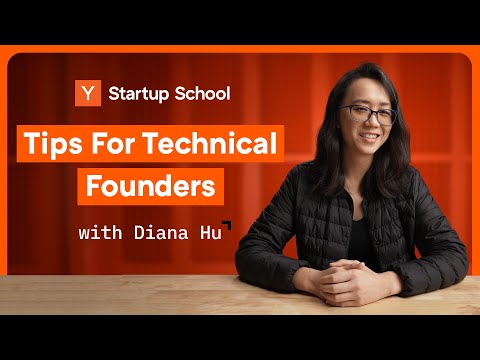
Jared Friedman of Y Combinator moderates a Startup School panel with technical founders from PlanGrid, Segment, ObEN Reality, and Second Measure on building products, engineering teams, and startup technology.
Gootee’s first blueprint viewer took a month to build after he discovered that large PDF files overwhelmed early iPads. Segment’s founders tried a lecture tool and a user analytics product before testing a shared data API; a landing page collected about 500 emails, and they built a hosted version in a week. Hu’s team spent time making augmented reality algorithms run well on phones, then found interest from game developers. Second Measure used quick user testing to learn that customers needed guided insights rather than an unrestricted data exploration tool.
The panel says early teams often prioritize shipping and learning, while adding tests, CI, and security as users, systems, and teams grow. Segment described moving from hackathon-style development to stronger testing and data handling, especially after signing enterprise customers paying more than six figures annually. Gootee says PlanGrid treated security and scalability as essential from the start because construction projects depend on the software, including projects with hundreds of thousands of blueprints.
Panelists favor adjusting workflows to the team’s size instead of following a methodology rigidly. They discuss daily stand-ups, weekly planning, documentation, time-boxing, one-to-ones, and OKRs as tools teams can adopt when useful. For deadlines, they recommend communicating uncertainty, accounting for release constraints, and gathering independent estimates from team members.
The founders caution that outsourcing core technology can also outsource early product learning, though contractors may help with well-defined work or trial hiring. They describe different choices on remote work, shaped by company needs, communication, and documentation. In the audience discussion, panelists advise showing products to users early and often, and one suggests building disposable prototypes before committing to a first version.
Takeaways
- Test the hardest product assumption with a small prototype before building a full system.
- Use the technology your team knows when speed and learning matter most.
- Add engineering process as system complexity, team size, and customer reliance increase.
- Treat security and reliability according to the real cost of failure for your customers.
- Keep core product learning close to the company, and make user feedback part of development.
Mentioned in this talk


Search inside this talk
What was claimed 22
- metric
 PlanGrid: 350 people
“PlanGrid has 350 people.”
YouTube Unverified1 source· Talk
- role atRalph Gootee is CTO and co-founder atPlanGrid
“I’m CTO and co-founder of PlanGrid.”
YouTube Unverified1 source· Talk
- uses
“Our back end is mostly Python.”
YouTube Unverified1 source· Talk
- uses
“Our back end is mostly Python, with some Go.”
YouTube Unverified1 source· Talk
- uses
“Our stack is based on AWS.”
YouTube Unverified1 source· Talk
- metricSegment: About 300 microservices
“We’re running about 300 different microservices.”
YouTube Unverified1 source· Talk
- uses
“Our back end is primarily written in Go.”
YouTube Unverified1 source· Talk
- uses
“We’re built entirely on AWS.”
YouTube Unverified1 source· Talk
- builtNiantic built
 Pokémon Go
“Niantic, the makers of Pokémon Go.”
YouTube Verified2 sources· Talk
- acquiredNiantic acquired ObEN Reality
“My company just got acquired by Niantic.”
YouTube Unverified1 source· Talk
- role atDiana Hu is founder and CTO at ObEN Reality
“I was the founder and CTO of ObEN Reality.”
YouTube Unverified1 source· Talk
- built
“We handle all the complexity with the computer vision algorithms, the backend interactions, and all the hard parts of getting things to render.”
YouTube Unverified1 source· Talk
- uses
“Back at ObEN, we had a service hosted in AWS.”
YouTube Unverified1 source· Talk
- uses
“Our service is also written in C++.”
YouTube Unverified1 source· Talk
- usesObEN Reality uses C
“A lot of the bulk of our code is native C++.”
YouTube Unverified1 source· Talk
- metricSecond Measure: About 50 people
“We're about 50 people.”
YouTube Unverified1 source· Talk
- role atLillian is CEO at Second Measure
“I'm Lillian, CEO—not CTO—of Second Measure.”
YouTube Unverified1 source· Talk
- usesSecond Measure uses React
“Our front end is React-based.”
YouTube Unverified1 source· Talk
- uses
“We're also primarily on AWS.”
YouTube Unverified1 source· Talk
- featureSegment: A single API for sending customer data to multiple analytics and other tools.A single API for sending customer data to multiple analytics and other tools.
“The idea was that you'd use the same API to send us data as you would to Mixpanel, KISSmetrics, Google Analytics, and all these other tools.”
YouTube Unverified1 source· Talk
- metricSegment: About 1,000 GitHub stars on launch day
“It got about a thousand stars that first day on GitHub.”
YouTube Unverified1 source· Talk
- metricSegment: About 500 email sign-ups after the first week
“About 500 people left their email.”
YouTube Unverified1 source· Talk