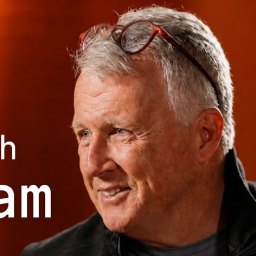

Graham says Viaweb grew from a practical desire to avoid writing software for Windows. He and his co-founders built a browser-based store builder, even though the idea seemed unusual and the first version was clunky. He says promising ideas can seem implausible at first, and their outcomes are hard to predict.
A Conversation
Speakers
Paul Graham, Y Combinator co-founder, talks with Y Combinator president Geoff Ralston at Startup School about building startups, choosing co-founders, and learning from users.
Graham describes choosing Robert Morris because they already worked well together, then recruiting Trevor Blackwell on Morris’s recommendation. He advises using trusted people to find capable collaborators, while assessing trustworthiness separately. Viaweb also served early customers manually, which taught the founders what to improve in their software.
Graham says founders should handle early work by hand, including finding customers and talking with them, instead of building elaborate systems before they understand the problem. Viaweb’s founders could not persuade stores to use their software, so they used it to build stores for customers themselves. He says steady growth from a small customer base can compound, while those early interactions help shape the product.
Graham says poor execution is a more common cause of failure than competition, citing one company out of 1,900 as having been killed by a competitor. He emphasizes a strong founding team that can withstand stress, and says determination matters more than exceptional intelligence. Ralston adds that founders need to navigate as their initial ideas improve, often by listening closely to users.
Graham warns founders against building from private assumptions, delaying launch out of embarrassment, or avoiding sales and user feedback. He says a product is ready to launch when at least one person can use it to do something they could not do before. In the Q&A, he recommends asking users about their lives and frustrations to uncover the problem behind their requests.
Takeaways
- Use early customer work to learn what product to build before automating it.
- Launch once someone can get real value from the product, even if it is unfinished.
- Talk with users about their problems and routines, not just their requested features.
- Choose co-founders who can work through stress together, and assess trustworthiness directly.
- Keep improving execution and customer understanding instead of fixating on competitors.
Mentioned in this talk

Search inside this talk
What was claimed 12
- foundedPaul Graham founded
 Y Combinator
“Paul Graham, Founder of Y Combinator”
0:00inPaul Graham, Founder of Y Combinator, Live from StockholmYouTube Verified9 sources· Talk, Web· archived
- previously atPaul Graham previously at
 YahooViaweb acquired by Yahoo! (became Yahoo! Store)
“you and I got to know each other ... at Yahoo, back in the late '90s”
YouTube Verified2 sources· Talk, Web· archived
- builtPaul Buchheit built
 Gmailcreator, original lead developer
“he's known as the inventor of Gmail”
0:03inPaul BuchheitYouTube Verified11 sources· Talk, Web· archived
- builtPaul Graham built Yahoo Mailimportant parts
“I wrote some important parts of Yahoo Mail”
YouTube Unverified1 source· Talk
- previously atGeoff Ralston previously atYahoo
“we created something called Rocketmail, and we were purchased in '97”
YouTube Unverified1 source· Talk
- acquired
“Paul's company was bought in '98”
YouTube Verified2 sources· Talk
- featureViaweb: Online store builder that ran on the server and was controlled through a browser
“you would have an online store builder”
YouTube Unverified1 source· Talk
- metricY Combinator: About 150 startups per batch; maybe five become giant
“about 150 startups per batch, of which maybe five will become giant”
YouTube Unverified1 source· Talk
- builtTrevor Blackwell built Viawebrewrote its software in Smalltalk
“he'd rewritten all our goddamn software in Smalltalk”
YouTube Unverified1 source· Talk
- metricY Combinator: One out of 1,900 companies killed by competitors
“How many companies have been killed by competitors? One out of 1,900.”
YouTube Unverified1 source· Talk
- previously atPaul Graham previously at
 Apple Computer
“You worked at Apple at one point after you got bought, didn't you?”
YouTube Unverified1 source· Talk
- launchedY Combinator: Less than a week after the idea; initial applications were ASCII forms by email
“We launched YC less than a week after having the idea.”
YouTube Unverified1 source· Talk