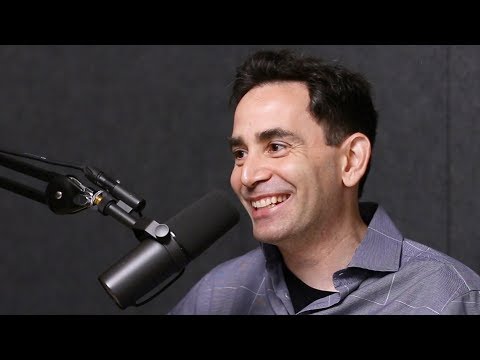
Lin describes how Tony Hsieh and Sanjay Madan started by building websites, then created a banner exchange to help small sites attract visitors. The network became more useful as it grew, and LinkExchange eventually sold to Microsoft. Lin joined from a statistics PhD program to handle finance, despite having no finance experience.
Alfred Lin with Justin Kan
Speakers
Alfred Lin, then a Sequoia Capital partner and former Zappos and LinkExchange operator, discusses building companies with YC’s Justin Kan at a Y Combinator event.
After LinkExchange, Lin and Hsieh started the Venture Frogs angel fund, investing in 27 companies in nine months. Lin says Tellme had raised $265 million and was losing about $60 million a year when he joined. The company narrowed its focus to enterprise voice automation and 12 to 24 large customers, growing to about $150 million in recurring revenue before Microsoft acquired it.
Lin says Zappos pursued online shoe sales because the market was large and mail order already accounted for about $2 billion of a $40 billion shoe business. Funding was difficult, so the company relied on debt and merchant credit, and aimed to be profitable on its first order. Its operating choices included round-the-clock fulfillment, shipping orders within hours, and tracking each item by a unique identifier.
Lin says culture needs daily attention to become a company’s core strength, much like customer service or fitness. He recounts Zappos facing a potential bank covenant breach after an inventory ordering error, and describes how earlier payroll scares helped him stay steady through later crises. His startup advice is to keep pursuing a big goal while making necessary pivots, and to solve a hard problem rooted in personal experience.
Lin advises founders to treat investors as long-term partners and spend time getting to know them before accepting funding. He says Sequoia looks for persistent founders with deep industry insight. Founders should challenge industry assumptions, choose a small number of priorities, and define a clear entry point into the market.
Takeaways
- A network can become more valuable as more participants join, so identify how each new user benefits existing users.
- Too much capital can weaken spending discipline; connect experiments to clear priorities.
- Test whether a business can work economically on its first transaction, especially when later customer value is uncertain.
- Treat culture as a daily operating practice, not a value statement.
- Spend time assessing investors as long-term partners, and focus your market entry on a clear wedge.
Mentioned in this talk


Search inside this talk
What was claimed 18
- role atAlfred Lin is director at
 Houzz
“He serves as a director at a bunch of awesome Silicon Valley companies like Airbnb and Houzz.”
YouTube Unverified1 source· Talk
- role atAlfred Lin is director at
 Airbnb
“He serves as a director at a bunch of awesome Silicon Valley companies like Airbnb and Houzz.”
YouTube Unverified1 source· Talk
- role atAlfred Lin is partner at
 Sequoia
“who’s a partner at Sequoia Capital”
YouTube Unverified1 source· Talk
- builtLinkExchange built network effects
“They linked these websites together.”
YouTube Unverified1 source· Talk
- acquired
 Microsoft acquired LinkExchange
“when we sold the company to Microsoft”
YouTube Unverified1 source· Talk
- role atAlfred Lin is VP of Finance at LinkExchange
“I became VP of Finance at LinkExchange.”
YouTube Unverified1 source· Talk
- foundedAlfred Lin founded Venture Frogs
“we left and started a small angel fund called Venture Frogs in 1999”
YouTube Unverified1 source· Talk
- invested inVenture Frogs invested in Zappos
“we decided to focus on two companies: Tellme Networks and Zappos”
YouTube Unverified1 source· Talk