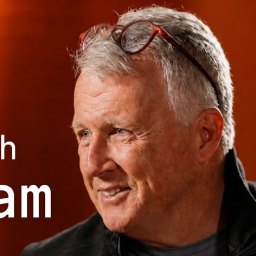
Buchheit says technology begins with patterns in people’s minds, and small everyday choices can shape larger outcomes. He urges founders to stay open to learning instead of treating experience or conventional wisdom as final answers. He points to Google’s failed 1997 attempt to sell for a million dollars as an example of how a valuable opportunity can look unimportant at first.
Paul Buchheit
Speaker
Paul Buchheit, Y Combinator partner and former Google early employee, shares his personal principles for innovation and startups at a Y Combinator event in London.
Buchheit compares recurring doubts and self-criticism to background programs consuming a computer’s resources. He recommends noticing those thoughts and practicing stillness to regain attention. When plans fail, he advises accepting the setback and looking for a way forward, as Uber did when London’s taxi strike created a growth opportunity.
Buchheit says he invested in Justin.tv because the idea seemed unusual and the founders believed in it. The service later enabled anyone to stream, and its gaming audience led to Twitch.tv. He describes promising startups as experiments where the outcome is uncertain but the learning is valuable.
Buchheit argues that enjoying the daily work is more useful than postponing happiness until a distant goal is reached. He recalls learning to enjoy running by focusing on each step, and says a meaningful mission can make difficult startup work feel worthwhile. He also urges founders to pursue ambitious ideas, citing Gmail’s JavaScript interface, which critics considered impractical before its launch.
Buchheit describes startups as systems that can channel self-interest toward larger missions, comparing money to fuel rather than the purpose of a rocket. His ambitious goal is a world where people have basic needs met and the freedom to choose work. He calls for founders to question established systems and pursue worthwhile problems they can help solve.
Takeaways
- Treat experience as input, not proof that a new idea cannot work.
- Notice recurring doubts and make room for focused thinking.
- When a setback happens, look for a useful next move.
- Choose experiments with uncertain outcomes that can teach you something.
- Build around work and a mission you value in the present.
Mentioned in this talk
 Google
 Meta
 UberAltaVistaFriendFeed
 GmailJustin.tvTwitch.tv
 Instagram
 JavaScriptweb browsersAssume you don't know anythingKill all daemon processesYes, and thank youChoose the more interesting pathLove what you doMaintain a healthy disregard for the impossible
 Justin KanSteve JobsSteve WozniakRichard Feynman
Search inside this talk
What was claimed 11
- builtPaul Buchheit builtGmailcreator, original lead developer
“he's known as the inventor of Gmail”
YouTube Verified11 sources· Talk, Web· archived
- invested inPaul Buchheit invested in Justin.tvearly angel investor
“he was an early angel investor in Justin.tv”
YouTube Unverified1 source· Talk
- works atPaul Buchheit works at
 Y Combinatorpartner
“Paul Buchheit is one of my partners at Y Combinator.”
YouTube Unverified1 source· Talk
- acquiredFriendFeed acquiredMeta
“which was acquired by Facebook”
YouTube Verified2 sources· Talk
- foundedPaul Buchheit founded FriendFeed
“He also started a startup shortly after leaving Google called FriendFeed”
YouTube Verified3 sources· Talk
- previously atPaul Buchheit previously atGoogle
“He was also one of the very early employees at Google”
YouTube Verified6 sources· Talk
- launchedchanged its name to focus on competitive gaming
“Eventually, they changed their name to Twitch.tv to focus exclusively on competitive gaming.”
YouTube Unverified1 source· Talk
- metricTwitch.tv: Fourth-largest source of U.S. internet traffic
“they are the fourth-largest source of U.S. internet traffic after Netflix, Google, and Apple”
YouTube Unverified1 source· Talk